Common Mistakes When Building a SaaS MVP and How to Avoid Them
September 2, 2026 · 15 min read
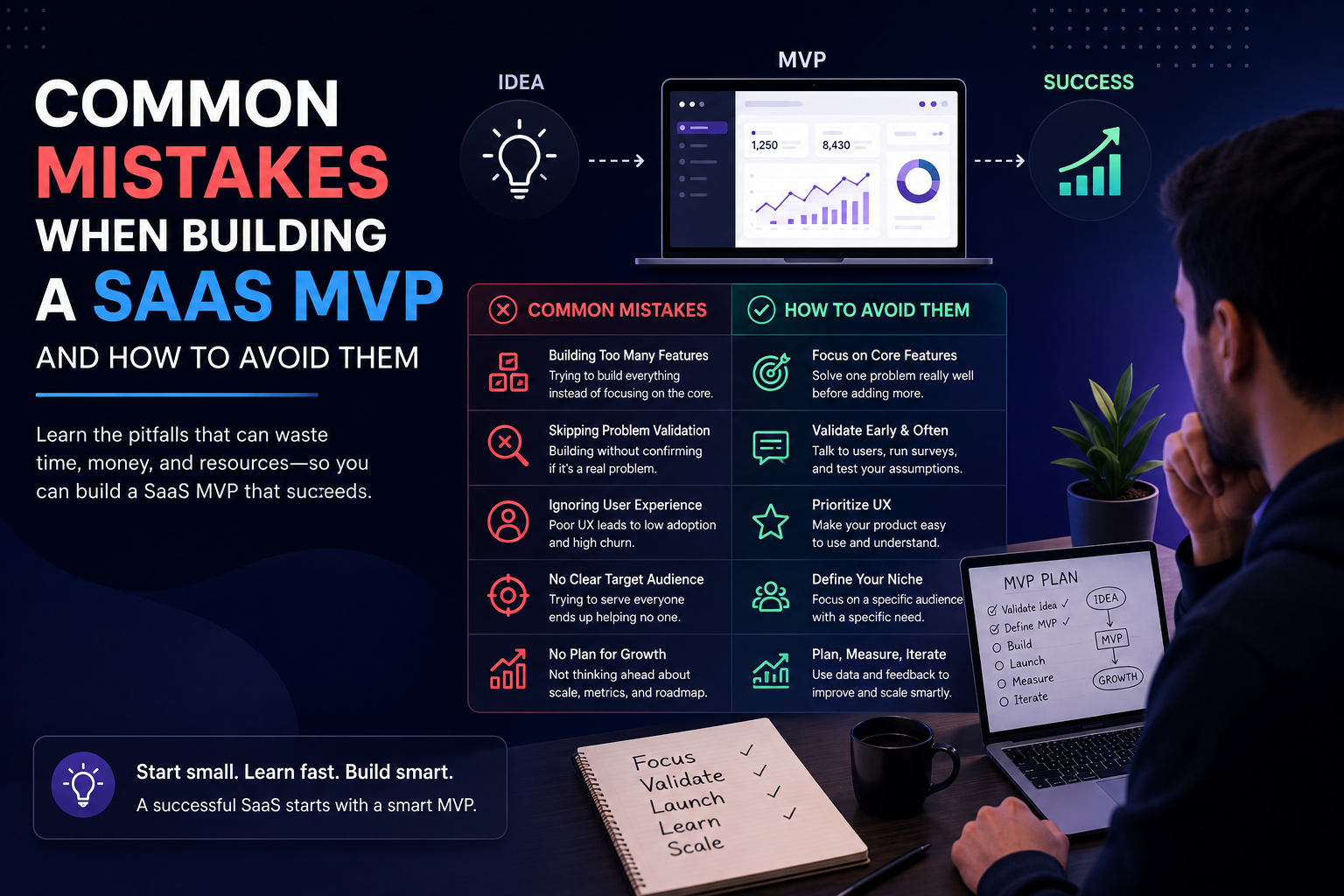
Building a SaaS MVP can be one of the smartest ways to test a software business idea without spending your entire budget on a full product.
However, building an MVP does not automatically guarantee success.
Many founders make critical mistakes during the planning, design, development, and launch stages. Some spend too much money building unnecessary features. Others launch too early with poor user experience. Some focus heavily on the technology while ignoring the actual customer problem.
These mistakes can turn what should have been a relatively simple MVP into an expensive and difficult software project.
If you are planning to build a SaaS product, understanding these mistakes before development begins can help you save money, reduce development time, and increase your chances of finding product market fit.
In this guide, we will explore the common mistakes when building a SaaS MVP, why they happen, and what you can do instead.
What Is a SaaS MVP?
A SaaS MVP, or Minimum Viable Product, is the first functional version of a Software as a Service product that contains the essential features required to solve a specific customer problem.
The objective is not to build the final version of your software.
The objective is to build enough of the product to:
- Solve a real problem
- Attract early users
- Test your assumptions
- Collect customer feedback
- Measure product usage
- Validate demand
- Determine whether customers are willing to pay
- Decide what should be developed next
A successful MVP should therefore be small enough to build efficiently but useful enough to provide real value.
This balance is where many founders struggle.
1. Trying to Build the Complete Product
One of the biggest SaaS MVP mistakes is trying to build everything at once.
A founder may have an idea for a SaaS product with 30 different features and decide that all 30 must be included in version one.
This creates unnecessary development costs and delays the launch.
For example, imagine you want to build a social media management SaaS.
Your long term product vision might include:
- Social media scheduling
- AI content generation
- AI image generation
- Video generation
- Analytics
- Team collaboration
- Approval workflows
- CRM
- Social listening
- Competitor monitoring
- Mobile apps
- Automated reporting
You probably don't need all of these features to validate the initial idea.
Your MVP could potentially focus on:
- User registration
- Social account connection
- Content creation
- Post scheduling
- Basic analytics
Once users demonstrate that they actually need the product, you can expand the platform.
How to Avoid This Mistake
Create a feature priority list and divide features into:
Must Have
Required for the core product to work.
Should Have
Useful but not essential for the first release.
Later
Features that can be developed after validation.
Your MVP should focus primarily on the first category.
2. Building Without Validating the Problem
Another common mistake is falling in love with the solution before confirming that customers actually care about the problem.
A founder might spend months developing an application only to discover that the target audience doesn't consider the problem important enough to pay for a solution.
Technology cannot solve a problem customers don't care about.
Before building your SaaS MVP, investigate:
- Who experiences the problem?
- How frequently does it happen?
- How are they currently solving it?
- How much does the problem cost them?
- What alternatives already exist?
- Would they pay for a better solution?
Customer interviews, surveys, competitor research, landing pages, and early waitlists can help validate your assumptions before significant development spending.
3. Choosing Features Based on Personal Preferences
Founders sometimes build features because they personally like them.
For example:
"I think users will love this dashboard."
But the important question is:
Do users actually need this dashboard?
Your preferences are not the same thing as customer demand.
A feature should ideally exist because it contributes to one or more of these objectives:
- Solves the customer's core problem
- Improves activation
- Improves retention
- Increases revenue
- Reduces customer effort
- Differentiates the product
If a feature doesn't contribute meaningful value, it may not belong in the MVP.
4. Choosing Technology Before Understanding the Product
Technology selection is important, but it should not be the first major decision.
Some founders begin with statements such as:
"I want to build it with this framework."
"I need microservices."
"I need Kubernetes."
"I need ten different APIs."
Before making these decisions, understand the product requirements.
Your technology stack should support the product, not become the product.
For many SaaS MVPs, a relatively straightforward architecture using technologies such as Django, FastAPI, Node.js, React, Next.js, PostgreSQL, or similar tools may be sufficient.
The best stack depends on the actual requirements.
Avoid Premature Technical Complexity
You probably don't need:
- Microservices for a tiny MVP
- Complex distributed systems
- Multiple databases without a clear reason
- Custom infrastructure for every service
- Highly complicated DevOps pipelines
Start with an architecture that is maintainable and capable of supporting your expected early users.
You can introduce more sophisticated infrastructure as the product grows.
5. Ignoring User Experience
An MVP does not mean you should build something confusing.
There is a difference between:
Minimum functionality
and
Minimum quality.
Your MVP can have fewer features while still providing an excellent user experience.
Poor UX can result in:
- User frustration
- Low activation
- High churn
- Support requests
- Negative reviews
- Low conversion rates
Pay attention to:
- Navigation
- Onboarding
- Forms
- Error messages
- Mobile responsiveness
- Loading states
- Empty states
- Checkout
- Account management
The user should be able to understand what the product does and how to use it without requiring a long explanation.
6. Designing for Everyone
Another mistake is trying to target everyone.
A SaaS product that attempts to serve:
- Freelancers
- Startups
- Large corporations
- Students
- Agencies
- E-commerce businesses
- Government organizations
may end up solving nobody's problem particularly well.
A strong MVP usually starts with a clearly defined target audience.
For example:
"An invoicing SaaS for small Nigerian service businesses."
is more specific than:
"An invoicing platform for everyone."
The narrower audience gives you a clearer understanding of:
- Their problems
- Their workflow
- Their pricing expectations
- Their language
- Their purchasing behavior
- Their most important features
You can expand your market later.
7. Underestimating Development Costs
Some founders assume that an MVP should be extremely cheap simply because it is an MVP.
That's not necessarily true.
Your MVP still requires:
- Product planning
- UI/UX design
- Frontend development
- Backend development
- Database architecture
- API development
- Authentication
- Testing
- Deployment
- Security
- Third party integrations
The cost depends heavily on the complexity of the product.
You should therefore create a realistic budget before development begins.
If you're interested in understanding the financial side of SaaS development, our guide on how much SaaS MVP development costs provides a useful framework for estimating your initial investment.
8. Choosing the Cheapest Developer
Trying to save money is understandable.
However, choosing a developer solely because they offer the lowest price can become an expensive mistake.
The cheapest quote may not include:
- Proper architecture
- Testing
- Documentation
- Security
- Deployment
- Maintenance
- Post launch support
You should evaluate a developer or development team based on:
- Relevant experience
- Previous SaaS projects
- Technical capability
- Communication
- Code quality
- Development process
- Testing practices
- Post launch support
The goal should not be to find the cheapest developer.
The goal should be to find the best value for your development budget.
9. Building Without a Clear Product Roadmap
Another mistake is starting development without knowing what happens after the MVP.
Your roadmap doesn't need to predict the next five years.
But you should have a basic understanding of:
Phase 1: MVP
Phase 2: User feedback and improvements
Phase 3: Product market fit
Phase 4: Growth and optimization
Phase 5: Scaling
This helps prevent random feature development.
Your MVP should be the first step in a product strategy, not an isolated software project.
10. Ignoring Security
Security should not be treated as something you add after gaining thousands of users.
Even an early stage SaaS application may handle:
- Personal information
- Business information
- Passwords
- Payment information
- Uploaded documents
- Customer records
- API credentials
Basic security practices should therefore be considered from the beginning.
These may include:
- Secure authentication
- Password hashing
- Authorization
- Input validation
- HTTPS
- Secure API design
- Environment variable management
- Database security
- Rate limiting
- Proper error handling
- Regular backups
You don't need enterprise level infrastructure on day one, but you should not deliberately build an insecure application either.
11. Forgetting Mobile Responsiveness
Many SaaS founders think about desktop users first and mobile users later.
That can be a problem.
Your customers may access your SaaS from:
- Smartphones
- Tablets
- Laptops
- Desktop computers
Your MVP should provide a usable experience across the devices that matter to your target audience.
You may not need a native mobile application initially.
A well designed responsive web application can often be enough for an MVP.
12. Adding Too Many Integrations
Integrations can make a SaaS product more powerful.
But every integration introduces additional complexity.
For example, integrating with:
- Microsoft
- Slack
- Stripe
- Paystack
- Flutterwave
- OpenAI
- HubSpot
- Salesforce
can quickly increase development and testing requirements.
Instead of integrating with ten platforms immediately, identify the one or two integrations that provide the most value to your initial customers.
Expand later based on demand.
13. Ignoring Performance
Your SaaS MVP doesn't need to be optimized for millions of users on day one.
But it should still feel reasonably fast.
Slow applications can hurt:
- User satisfaction
- Conversion
- Retention
- Search visibility
- Brand perception
Pay attention to:
- Database queries
- Image optimization
- API response times
- Frontend bundle size
- Caching
- Background processing
- Hosting configuration
The goal is not premature optimization.
The goal is to avoid obvious performance problems.
14. Building Without Analytics
One of the primary reasons for launching an MVP is learning from real users.
But how can you learn if you don't measure what they do?
Your SaaS should have some form of analytics or product monitoring.
Depending on your product, you may want to track:
- Signups
- Login frequency
- Onboarding completion
- Feature usage
- Trial activation
- Subscription conversion
- Churn
- User retention
- Errors
- Customer activity
For example, if 1,000 people sign up but only 80 use the core feature, you have discovered something important.
Your problem may not be marketing.
It could be onboarding or product usability.
15. Focusing on Vanity Metrics
Analytics are useful, but not every metric matters.
Founders sometimes celebrate:
- Website traffic
- Social media followers
- App downloads
- Total registrations
while ignoring whether users actually use and pay for the product.
A SaaS business should pay close attention to meaningful metrics such as:
- Activation rate
- Retention rate
- Monthly recurring revenue
- Customer acquisition cost
- Customer lifetime value
- Churn rate
- Conversion rate
A thousand registrations mean very little if users don't return to your product.
16. Launching Without a Customer Acquisition Strategy
Building the SaaS is only half of the challenge.
You also need users.
Some founders spend months developing their product and only start thinking about marketing after launch.
That can create a frustrating situation where the product is ready but nobody knows it exists.
Start thinking about customer acquisition before launch.
Potential channels include:
- SEO
- Content marketing
- Social media
- Email marketing
- Paid advertising
- Communities
- Partnerships
- Cold outreach
- Referral programs
- Product directories
Your acquisition strategy should match your target customer.
17. Trying to Perfect the MVP Before Launch
Perfectionism can delay an MVP indefinitely.
You may spend weeks changing:
- Button colors
- Dashboard layouts
- Logos
- Animations
- Minor wording
- Small interface details
while avoiding the most important step:
Putting the product in front of real users.
Your MVP should be good enough to use and reliable enough to test.
Then let real customer feedback guide improvements.
Remember:
You cannot validate a product that nobody can use.
18. Ignoring Customer Feedback
Launching your MVP is not the finish line.
It is the beginning of the learning process.
Talk to your users.
Ask:
- What problem were you trying to solve?
- What did you expect the product to do?
- What was confusing?
- What feature did you expect but couldn't find?
- What would make you use the product more?
- Would you recommend it?
- Would you pay for it?
But don't automatically build every feature customers request.
Look for patterns.
If dozens of customers independently experience the same problem, that signal is much stronger than one customer requesting a feature.
19. Not Planning for Maintenance
Software is never truly finished.
After launch, you may need to handle:
- Bugs
- Security updates
- Dependency upgrades
- API changes
- Performance improvements
- Infrastructure changes
- New features
- Database maintenance
This is why maintenance should be included in your SaaS business plan from the beginning.
Zeecomedia's maintenance and support services can help businesses keep their web applications stable, secure, and continuously improved after launch.
20. Building Before Understanding the Business Model
A technically impressive SaaS product can still fail if the business model doesn't work.
Before development, understand how the product will make money.
Possible SaaS models include:
- Monthly subscription
- Annual subscription
- Freemium
- Usage based pricing
- Per user pricing
- Tiered pricing
- Enterprise licensing
Your pricing model should align with the value customers receive.
For example, charging $10 per month for a product that saves a business $10,000 per month may be too cheap.
On the other hand, charging $500 per month for a product targeting individuals with very low purchasing power may make customer acquisition difficult.
Your pricing should be tested and refined alongside the product.
How to Build a Better SaaS MVP
Avoiding mistakes becomes easier when you follow a structured process.
A practical SaaS MVP development process looks like this:
Step 1: Identify a Real Problem
Start with the customer's problem rather than the technology.
Step 2: Define Your Target Customer
Know exactly who you are building for.
Step 3: Validate the Idea
Use interviews, surveys, landing pages, competitor analysis, or preorders where appropriate.
Step 4: Define the Core Value Proposition
Explain clearly what your SaaS does and why customers should care.
Step 5: Prioritize Features
Separate essential MVP functionality from future features.
Step 6: Design the User Experience
Create the key user flows before development.
Step 7: Choose the Technology Stack
Select technologies based on product requirements, development speed, maintainability, and scalability needs.
Step 8: Develop the MVP
Build the smallest useful version of the product.
Step 9: Test Thoroughly
Fix critical bugs and usability problems before launch.
Step 10: Launch to Early Users
Don't wait until everything is perfect.
Step 11: Measure User Behavior
Track activation, retention, conversion, usage, and other relevant metrics.
Step 12: Improve Based on Evidence
Use real customer feedback and product data to determine what to build next.
A Simple SaaS MVP Checklist
Before launching your MVP, ask yourself:
Product
- Does the product solve a specific problem?
- Is the target customer clearly defined?
- Is the core value proposition clear?
Features
- Have unnecessary features been removed?
- Can users complete the primary task?
- Are the most important workflows functional?
Technical
- Is authentication secure?
- Is the database properly structured?
- Are APIs working correctly?
- Is the application responsive?
- Have critical bugs been fixed?
Business
- Do you know how you will acquire customers?
- Is your pricing model defined?
- Do you have a way to collect payments?
- Do you know which metrics you need to monitor?
Launch
- Can users understand the product?
- Is onboarding straightforward?
- Is analytics installed?
- Do you have a feedback mechanism?
- Do you have a plan for ongoing maintenance?
If you can answer these questions confidently, you are in a much stronger position to launch.
Final Thoughts
Building a SaaS MVP is not about building the biggest application possible.
It is about building the smallest useful product that can generate meaningful business and customer insights.
The biggest mistakes usually come from doing too much too early.
You don't need 50 features.
You don't need millions of users before learning from customers.
You don't need a massive infrastructure setup before validating demand.
And you don't need to build the final version of your SaaS on day one.
Start with a clearly defined problem.
Build the essential solution.
Launch it.
Measure what users do.
Listen to customers.
Then improve the product based on evidence.
If you have a SaaS idea but you're unsure about what features belong in your MVP, what technology to use, or how to structure the development process, Zeecomedia's web application development services can help you turn your idea into a practical and scalable SaaS product.
Once the product is launched, Zeecomedia's maintenance and support services can also help you maintain, improve, and scale your application as your user base grows.