How Much Does SaaS MVP Development Cost? 2026 Guide
September 2, 2026 · 16 min read
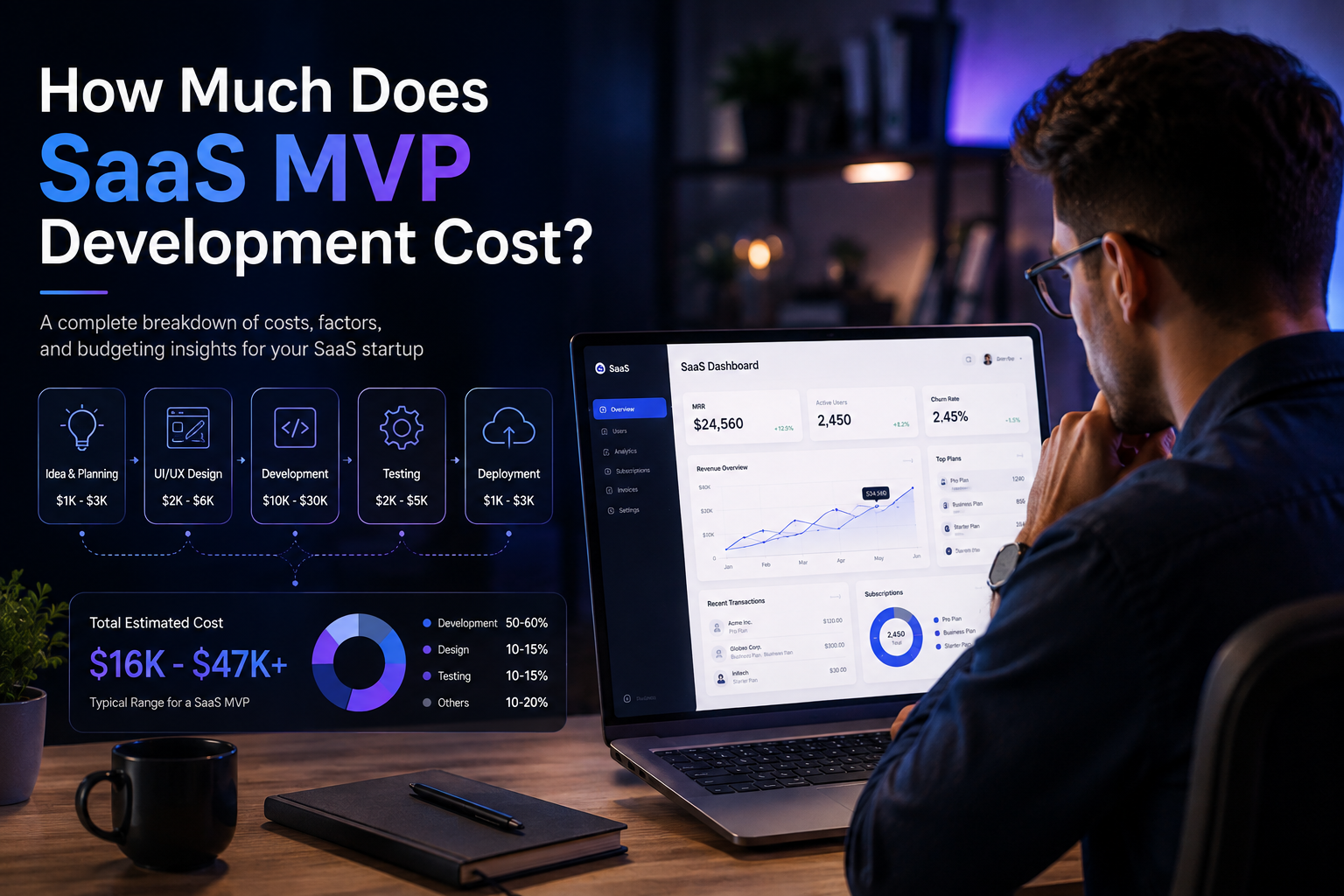
Building a SaaS product sounds exciting until you start asking one important question:
How much will it actually cost to build?
The answer is not as simple as giving you one fixed price.
The cost of SaaS MVP development depends on several factors, including the complexity of your idea, the features you want, the technology stack, the development team you hire, the level of UI/UX design required, third party integrations, security requirements, and how quickly you want to launch.
A simple SaaS MVP can potentially be developed for a few thousand dollars, while a more complex product can require tens of thousands of dollars or more.
The important thing is not simply to ask, "How much does a SaaS MVP cost?"
You should ask:
What is the minimum investment required to build a useful product, validate the idea, acquire early users, and determine whether the product is worth scaling?
This guide explains the major factors that influence SaaS MVP development costs and how you can control your budget without compromising the quality of your product.
What Is a SaaS MVP?
A SaaS MVP, or Software as a Service Minimum Viable Product, is the first functional version of your software product that contains enough features to solve a specific customer problem and allow you to collect real user feedback.
An MVP is not supposed to be the final version of your SaaS.
Instead, it is designed to answer critical questions such as:
- Do customers actually have this problem?
- Will they use the solution?
- Are they willing to pay for it?
- Which features do they actually need?
- Can the business acquire customers profitably?
- Is the product worth investing more money into?
For example, imagine you want to build an AI platform that helps businesses generate marketing content.
Your final vision might include:
- AI content generation
- AI image generation
- AI video generation
- Social media scheduling
- Team collaboration
- Analytics
- Content calendars
- Multiple AI models
- Custom brand voices
- Integrations with social media platforms
- Advanced billing
- Mobile applications
Building all of these features from day one could become extremely expensive.
A SaaS MVP might start with only:
- User registration
- User dashboard
- AI content generation
- Basic usage limits
- Subscription payment
- User account management
- Simple administration panel
That smaller product could be launched much faster and at a significantly lower cost.
How Much Does SaaS MVP Development Cost?
There is no universal SaaS MVP development price because every product is different.
However, a practical way to think about the budget is:
| SaaS MVP Type | Typical Development Complexity | Approximate Budget | | ----------------- | ---------------------------------------------------- | ------------------: | | Very simple MVP | Basic CRUD, authentication, dashboard | $3,000 to $7,000 | | Standard SaaS MVP | Dashboard, payments, APIs, user roles | $7,000 to $15,000 | | Advanced SaaS MVP | Multiple integrations, automation, complex workflows | $15,000 to $30,000+ | | Complex SaaS MVP | AI, real time features, advanced architecture | $30,000+ |
These figures are general planning ranges, not fixed quotes.
A product with fewer features can cost more than another product with many screens if its underlying business logic and infrastructure are significantly more complicated.
The best way to control the cost is therefore not simply to find the cheapest developer.
It is to control scope and complexity.
The Major Factors That Determine SaaS MVP Cost
Several components contribute to the overall cost of building a SaaS MVP.
Let's examine the most important ones.
1. Product Complexity
The complexity of your SaaS idea is probably one of the biggest cost drivers.
A simple appointment management platform is generally easier to build than a platform that uses AI to analyze thousands of documents and produce automated recommendations.
For example:
Simple SaaS
A basic appointment booking platform might require:
- User registration
- Business profile
- Service management
- Calendar
- Appointment booking
- Notifications
- Admin dashboard
Complex SaaS
A business intelligence platform might require:
- Data ingestion
- Multiple APIs
- Data processing
- Custom dashboards
- Role based permissions
- Automated reports
- Real time updates
- Data visualization
- Advanced analytics
- Third party integrations
The second product will naturally require more development time and therefore a larger budget.
2. Number of MVP Features
Every feature adds development work.
This is why one of the most important SaaS development principles is:
Do not build everything you can imagine. Build what you need to validate the business.
Suppose you have 30 potential features.
You may discover that only 6 are necessary for your MVP.
Instead of spending money building all 30 features, you can launch with the 6 core features, collect feedback, and gradually introduce additional functionality.
This approach can dramatically reduce your initial SaaS MVP cost.
3. UI/UX Design
Design is another important component of your development budget.
Your SaaS needs more than attractive screens.
It needs an interface that allows users to understand the product and accomplish tasks easily.
UI/UX development can include:
- User flows
- Wireframes
- Design systems
- Dashboard design
- Responsive layouts
- Mobile interfaces
- Forms
- Navigation
- Empty states
- Error states
- Onboarding
- Accessibility considerations
A basic MVP may require a relatively simple interface.
A sophisticated B2B SaaS product with multiple dashboards and user roles will require considerably more design work.
4. Frontend Development
The frontend is what your users interact with.
Depending on your product, it may include:
- Landing page
- Registration
- Login
- Dashboard
- Account settings
- Billing interface
- Forms
- Reports
- Data visualization
- Notifications
- Responsive mobile interface
Technologies such as React or Next.js can be used to build modern SaaS interfaces.
The more interactive and dynamic the application is, the more frontend development time may be required.
5. Backend Development
The backend is where much of the core SaaS functionality happens.
It may handle:
- Authentication
- Authorization
- Business logic
- Database operations
- API endpoints
- Subscription management
- File processing
- Notifications
- Background tasks
- Integrations
- Security
- Data validation
For example, a SaaS product with simple user accounts and basic CRUD operations may have a relatively straightforward backend.
A SaaS product with complex workflows, multiple user roles, subscriptions, automation, AI processing, and external integrations will require significantly more backend engineering.
6. Database Architecture
Your SaaS needs somewhere to store its data.
Common database technologies include PostgreSQL, MySQL and other database systems depending on the application's requirements.
The cost isn't simply about creating database tables.
Proper SaaS database design may involve:
- User data
- Organizations
- Teams
- Subscriptions
- Transactions
- Usage records
- Permissions
- Application data
- Audit logs
- Relationships between entities
Poor database architecture can create serious problems when your SaaS begins to scale.
This is why it is usually better to design your MVP with future growth in mind without overengineering it.
7. Authentication and User Management
Almost every SaaS product requires user authentication.
This can include:
- Email registration
- Login
- Password reset
- Email verification
- Social authentication
- Two factor authentication
- User profiles
- Account management
- Organization accounts
- Role based access
A simple authentication system is relatively straightforward.
However, enterprise authentication and advanced permission systems can substantially increase development complexity.
8. Payment and Subscription Integration
If your SaaS makes money through subscriptions, you need a reliable billing system.
Depending on your target market, you may need integrations with payment providers such as Stripe or other regional payment platforms.
Your MVP may need:
- Monthly subscriptions
- Annual subscriptions
- Free trials
- Payment processing
- Subscription upgrades
- Subscription cancellation
- Payment history
- Usage limits
- Failed payment handling
Billing can become complicated quickly, particularly when your pricing model involves usage based billing or multiple subscription tiers.
9. Third Party Integrations
Integrations can significantly influence SaaS development costs.
For example, your product might need to connect with:
- Microsoft
- Slack
- Paystack
- Flutterwave
- Stripe
- OpenAI
- Other AI APIs
- CRM platforms
- Email providers
- Cloud storage services
Each integration requires development, testing, authentication, error handling, and ongoing maintenance.
The more external systems your SaaS depends on, the more complex the product becomes.
10. AI Features
AI powered SaaS products can require additional development work.
For example, an AI SaaS might require:
- AI API integration
- Prompt management
- Model selection
- Usage tracking
- Token management
- File processing
- AI response validation
- Conversation history
- Rate limiting
- Cost monitoring
- Content moderation
The AI API itself may have usage costs separate from the software development cost.
Therefore, if you are building an AI SaaS MVP, you should distinguish between:
Development costs
and
Ongoing AI infrastructure and API costs.
11. Hosting and Infrastructure
Your SaaS application needs infrastructure to operate.
Depending on the product, this may include:
- Application hosting
- Database hosting
- Object storage
- CDN
- Email service
- Background workers
- Caching
- Monitoring
- Logging
- Backup systems
For an MVP, you generally don't need an extremely expensive infrastructure setup.
A properly designed MVP can often start with a relatively modest infrastructure footprint and scale as usage increases.
12. Testing and Quality Assurance
Testing is frequently overlooked when founders calculate SaaS MVP costs.
However, releasing software without adequate testing can create expensive problems.
Testing may include:
- Functional testing
- API testing
- Authentication testing
- Payment testing
- Responsive testing
- Browser testing
- Security checks
- Performance testing
- User acceptance testing
The objective isn't to make the MVP perfect.
The objective is to make it reliable enough for real users to use and provide meaningful feedback.
13. Maintenance and Support
Launching your SaaS is not the end of the development process.
Once users start interacting with your product, you will discover:
- Bugs
- UX problems
- Performance bottlenecks
- New feature requests
- Integration changes
- Security concerns
This is why SaaS founders should budget for ongoing maintenance.
A strong development partner can help with SaaS maintenance and support after the initial MVP launch.
SaaS MVP Development Cost by Development Approach
Another major factor is who builds the product.
There are several approaches.
Building the SaaS Yourself
If you have strong programming skills, you can build the MVP yourself.
Your direct development cost may be relatively low.
However, your real cost is your time.
If you spend six months building software that could have been launched in eight weeks, the opportunity cost can become significant.
DIY development can make sense when:
- You are a technical founder
- The product is relatively simple
- You have sufficient time
- You understand your target users
- You want maximum control
Hiring a Freelancer
Freelancers can be a cost effective option for certain SaaS MVPs.
The advantage is that you may find specialized developers without maintaining a full development team.
However, you need to carefully evaluate:
- Technical experience
- Previous SaaS projects
- Communication
- Code quality
- Availability
- Post launch support
A cheap freelancer who produces difficult to maintain code can ultimately cost more than a competent developer.
Hiring a Development Agency
A software development agency typically provides a broader team and development process.
Depending on the agency, you may have access to:
- Product planning
- UI/UX designers
- Frontend developers
- Backend developers
- QA engineers
- DevOps engineers
- Project management
This can be more expensive than hiring a single freelancer, but it can also reduce the risks associated with managing multiple technical responsibilities yourself.
For businesses that want a structured development process, Zeecomedia's web application development services can help turn a SaaS concept into a functional web product.
How to Reduce SaaS MVP Development Cost
Reducing development costs does not mean choosing the cheapest developer.
It means eliminating unnecessary complexity.
Here are practical ways to reduce your budget.
Start With One Core Problem
Don't build a platform that tries to solve ten problems.
Start with one major customer problem.
For example:
Instead of building an entire business management platform, build a tool that solves one specific operational problem extremely well.
Prioritize Features
Create three categories:
Must Have
Features required for the product to work.
Should Have
Useful features that can improve the experience but are not necessary for launch.
Later
Features that can be added after you validate demand.
Your MVP should primarily contain the Must Have features.
Use Existing APIs
You don't always need to build everything from scratch.
You can use existing services for:
- Payments
- Authentication
- AI
- Maps
- Notifications
- File storage
- Analytics
This can significantly reduce development time.
Avoid Premature Scaling
If you have 100 users, you probably don't need infrastructure designed for 100 million users.
Build an architecture that can scale, but don't spend your entire MVP budget solving problems you don't have yet.
Build Web First
If your product can work effectively as a web application, consider launching the web version before developing native mobile applications.
Building iOS and Android applications simultaneously can significantly increase the initial development budget.
Validate the product first.
Then expand.
Example SaaS MVP Budget
Imagine you want to build a subscription based SaaS platform for small businesses.
Your MVP might include:
- Landing page
- User registration
- Login
- Dashboard
- Core SaaS functionality
- Subscription billing
- User profile
- Admin dashboard
- Email notifications
- Basic analytics
A simplified budget could look like this:
| Development Area | Example Budget | | -------------------- | --------------------: | | Product planning | $500 to $1,500 | | UI/UX design | $800 to $2,500 | | Frontend development | $1,500 to $4,000 | | Backend development | $2,000 to $5,000 | | Payment integration | $300 to $1,000 | | Testing | $500 to $1,500 | | Deployment | $300 to $1,000 | | Estimated total | $5,900 to $16,500 |
Again, this is an illustrative planning range.
Your actual cost depends on your product requirements, development team, location, technology choices, integrations and scope.
The Cheapest SaaS MVP Is Not Always the Best MVP
There is a major difference between cheap development and cost efficient development.
A cheap MVP might save money today but create problems later because of:
- Poor architecture
- Security vulnerabilities
- Unmaintainable code
- Bad database design
- Slow performance
- Poor user experience
- Lack of documentation
- Difficult integrations
Cost efficient development focuses on building only what matters while maintaining enough technical quality to support future improvements.
The goal should be:
Build small, validate quickly, learn from users, and scale intelligently.
What Should Your SaaS MVP Budget Include?
Before hiring a developer, your budget should account for more than coding.
Consider these categories:
Initial Development
The actual design and engineering work.
Infrastructure
Hosting, database, storage, email and other services.
Third Party APIs
Payment gateways, AI APIs, communication APIs and other external services.
Testing
Quality assurance before and after launch.
Maintenance
Bug fixes, updates and technical support.
Marketing
Your SaaS cannot generate revenue if nobody knows it exists.
You may need money for:
- SEO
- Content marketing
- Paid advertising
- Social media
- Influencer marketing
- Sales
- Outreach
This is one of the biggest mistakes founders make.
They spend almost all their money building the product and leave nothing for customer acquisition.
Should You Spend $5,000 or $20,000 on Your SaaS MVP?
The answer depends on what you are trying to validate.
If your idea can be validated with a $5,000 MVP, there may be little reason to spend $20,000.
However, if your core value proposition requires advanced technology, complex integrations or sophisticated infrastructure, trying to force the project into a very small budget could compromise the product.
Ask yourself:
What is the minimum amount I need to invest to prove that customers want this solution?
That is a much better question than:
How cheaply can I build this?
When Should You Increase Your SaaS MVP Budget?
You should consider increasing your budget when additional investment directly improves your ability to validate or deliver the core product.
For example:
- Your product requires complex AI processing
- Your SaaS depends on several external APIs
- You need advanced security
- You require real time functionality
- You have multiple user roles
- Your application processes sensitive business data
- Your product requires complex automation
- Your target customers expect a highly polished experience
In these situations, cutting development costs too aggressively can create more problems than it solves.
What Happens After the SaaS MVP?
The MVP is only the beginning.
Once your product launches, you should monitor:
- User acquisition
- Activation
- Retention
- Conversion rate
- Churn
- Customer acquisition cost
- Lifetime value
- Feature usage
- Customer feedback
- Revenue
These metrics help you determine what to build next.
If users consistently request a particular feature and it contributes to retention or revenue, that feature may become a priority.
If nobody uses a feature, you may not need to spend additional money improving it.
This creates a continuous cycle:
Build → Launch → Measure → Learn → Improve → Scale
That is the real advantage of the MVP approach.
Final Thoughts
The cost of SaaS MVP development can vary significantly depending on the product.
A relatively simple MVP may require only a few thousand dollars, while a complex SaaS platform involving AI, advanced integrations, real time functionality and sophisticated infrastructure can require a much larger investment.
But the most important lesson is this:
Don't spend your entire budget trying to build the final product before you know whether customers want it.
Start with the smallest useful version.
Solve one meaningful problem.
Get it into the hands of real users.
Collect feedback.
Measure usage.
Then invest more money into the features and infrastructure that demonstrate real demand.
If you have a SaaS idea and you're unsure about the features, technology stack, development approach or estimated budget, Zeecomedia's web application development team can help you transform the idea into a practical MVP development plan.
And once your product is live, you can also leverage Zeecomedia's maintenance and support services to keep the application secure, stable and ready for continuous improvement.