In House vs. Outsourced SaaS Development: Which Is Better?
September 8, 2026 · 13 min read
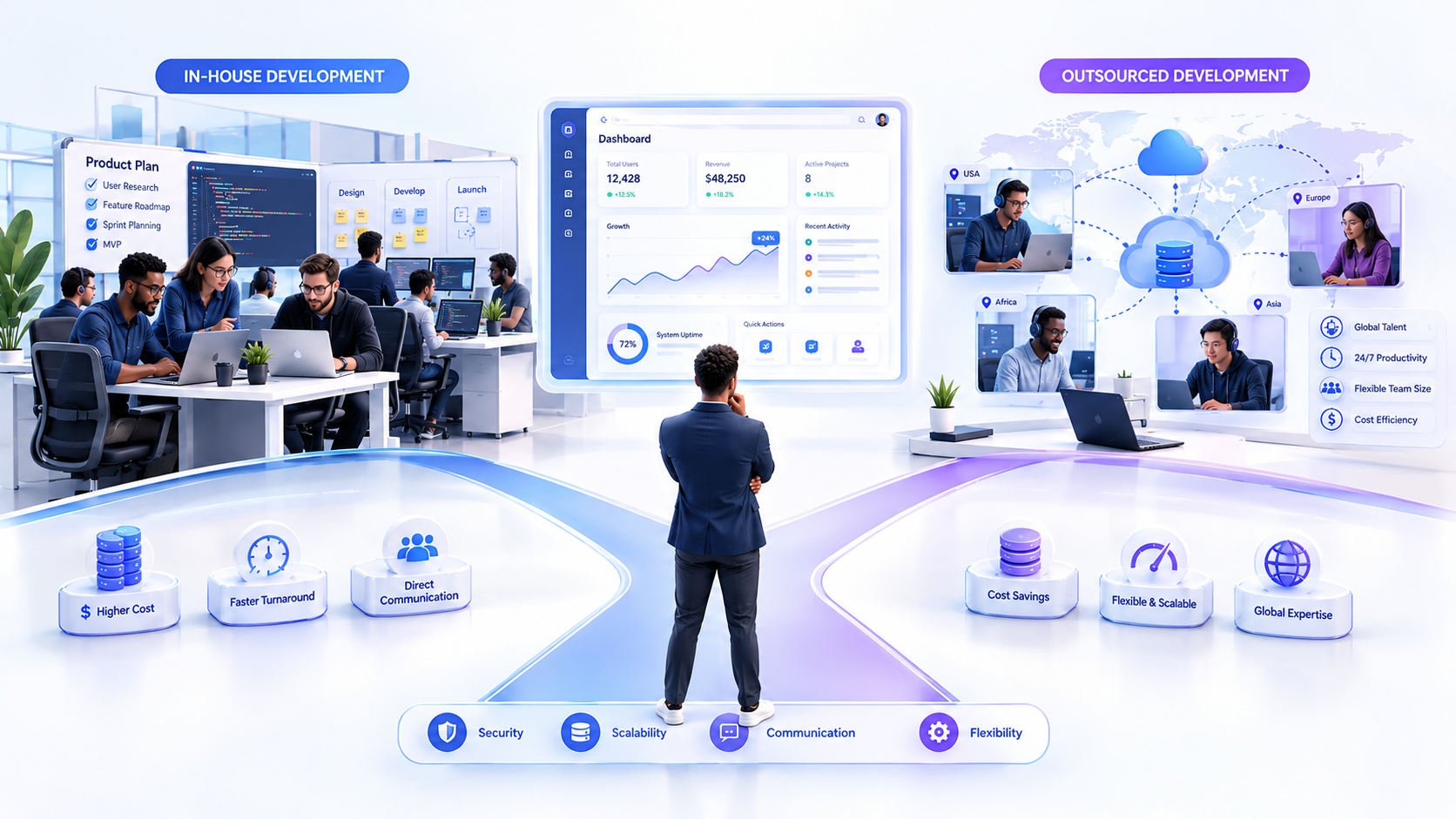
You have a SaaS idea.
You know the problem you want to solve, you have identified your target users, and you are ready to turn the idea into a real product.
Then comes an important decision:
Should you build your SaaS product with an in house development team or outsource the development to a SaaS development company?
This decision can affect your development costs, timeline, technical capabilities, product quality, scalability, and long term maintenance.
There is no universal answer.
The right choice depends on your budget, product complexity, internal expertise, timeline, and long term business strategy.
In this guide, we will compare in house vs. outsourced SaaS development and explain the advantages, disadvantages, costs, and situations where each approach makes sense.
What Is In House SaaS Development?
In house SaaS development means building and maintaining your software product using employees who work directly for your company.
You may need to hire professionals such as:
- Software engineers
- Frontend developers
- Backend developers
- UI/UX designers
- DevOps engineers
- QA engineers
- Product managers
- Project managers
Your company is responsible for assembling and managing the development team.
This approach gives you direct control over the people building your product.
What Is Outsourced SaaS Development?
Outsourced SaaS development means hiring an external software development company, agency, or development team to build your product.
Instead of recruiting and managing every technical role internally, you work with an external partner that already has the required expertise.
Depending on the company, outsourced SaaS development can cover:
- Product discovery
- UI/UX design
- MVP development
- Backend development
- Frontend development
- API development
- Database architecture
- Cloud deployment
- Testing
- Security
- Maintenance
This can allow businesses to start development without building a large internal engineering department first.
In House vs. Outsourced SaaS Development
The biggest difference is control versus flexibility.
An in house team gives you greater direct control over your developers, processes, and technical decisions.
Outsourcing can give you faster access to specialized expertise without requiring you to build the entire team internally.
Let's examine both approaches in more detail.
The Advantages of In House SaaS Development
1. Greater Control
With an internal team, your developers work directly under your company's management.
You can establish:
- Coding standards
- Development processes
- Communication systems
- Product priorities
- Security policies
- Engineering culture
This level of control can be valuable for companies building a long term technology business.
2. Deeper Product Knowledge
An internal development team can become deeply familiar with your product.
Over time, developers understand:
- Your architecture
- Your customers
- Your business model
- Your product roadmap
- Your internal processes
This knowledge can make future development easier.
3. Long Term Team Integration
An internal engineering team becomes part of your organization.
Developers can work closely with product managers, marketing teams, customer support, sales teams, and company leadership.
This can create stronger collaboration between technology and other areas of the business.
4. Direct Communication
Communication can be easier when everyone works within the same organization.
Instead of communicating through an external project manager or account manager, your product team can communicate directly with developers.
This can be particularly useful when the product changes frequently.
The Disadvantages of In House SaaS Development
1. Higher Hiring Costs
Building an internal SaaS development team can be expensive.
You may need to pay:
- Salaries
- Benefits
- Recruitment costs
- Equipment
- Software licenses
- Office expenses
- Training
- Management costs
And you may need several specialists rather than one developer.
2. Recruitment Takes Time
Finding experienced developers can take weeks or months.
Finding specialists with experience in SaaS architecture, cloud infrastructure, security, AI, payments, or other specialized areas can be even more challenging.
This can delay your product launch.
3. Employee Turnover
What happens if your lead developer leaves?
You may lose valuable knowledge about the architecture and codebase.
Replacing experienced technical talent can also be expensive.
4. Managing the Team Becomes Your Responsibility
You are not only building a SaaS product.
You are also managing an engineering organization.
That means dealing with:
- Hiring
- Performance management
- Team structure
- Technical leadership
- Training
- Project management
- Employee retention
For an early stage startup, this can consume valuable time.
The Advantages of Outsourced SaaS Development
1. Access to Specialized Expertise
An experienced SaaS development company may already have developers, designers, QA engineers, DevOps specialists, and technical architects.
Instead of spending months building your team, you can gain access to an existing team.
2. Faster Project Start
Outsourcing can allow you to begin development much faster.
You do not necessarily have to:
- Write job descriptions
- Advertise positions
- Interview candidates
- Negotiate salaries
- Onboard employees
- Build your engineering processes
You can work with an existing development team instead.
3. Potentially Lower Initial Costs
Outsourcing does not automatically mean cheaper development.
However, it can reduce the initial costs associated with building a complete internal team.
You pay for the development services you need rather than immediately taking on the full cost of an engineering department.
4. Flexible Team Size
Your development requirements may change throughout the project.
During the MVP phase, you may need a small team.
Later, you may need additional developers, designers, QA engineers, or DevOps expertise.
An outsourced team can potentially scale its resources according to your requirements.
5. Access to Multiple Skill Sets
Building a SaaS product can require many different technical skills.
An outsourced company may provide access to specialists in:
- Frontend development
- Backend development
- Mobile development
- Cloud computing
- Database engineering
- UI/UX
- Quality assurance
- Cybersecurity
- AI integration
This can be difficult and expensive to replicate internally.
The Disadvantages of Outsourced SaaS Development
1. Less Direct Control
When working with an external development company, you may have less direct control over the developers.
Communication usually happens through established project management processes.
This is not necessarily a problem, but you need clear communication from the beginning.
2. Finding the Right Partner Can Be Difficult
Not every development company has the same level of expertise.
Some may have excellent technical capabilities.
Others may lack experience with complex SaaS products.
You should carefully evaluate:
- Portfolio
- Technical expertise
- Client reviews
- Development process
- Communication
- Security practices
- Pricing
- Post launch support
3. Potential Communication Challenges
Working with an external team can introduce communication issues, particularly when teams operate in different time zones or have unclear responsibilities.
A strong project management process can reduce these problems.
4. Vendor Dependency
If your entire product depends on an external company, switching providers later can be difficult.
This is why you should establish clear agreements around:
- Source code ownership
- Intellectual property
- Documentation
- Infrastructure access
- Database access
- Deployment
- Credentials and permissions
You should always understand what happens if the relationship ends.
In House vs. Outsourcing: Cost Comparison
Cost is one of the biggest factors businesses consider.
But comparing a developer's salary directly with an agency's project price can be misleading.
For an internal team, your actual cost may include:
- Recruitment
- Salaries
- Benefits
- Equipment
- Software
- Management
- Training
- Office expenses
- Employee turnover
Outsourcing may involve:
- Development fees
- Project management
- Design
- Testing
- Infrastructure
- Maintenance
The actual cost depends on the scope and complexity of your SaaS product.
Instead of asking:
"Which option is cheaper?"
Ask:
"Which option provides the best value for the stage my business is currently in?"
In House vs. Outsourced SaaS Development: Which Is Faster?
If you already have an experienced internal engineering team, in house development can move quickly.
But if you are starting from zero, outsourcing may provide a faster path to development.
For example, imagine you need:
- Two backend developers
- Two frontend developers
- A UI/UX designer
- A QA engineer
- A DevOps engineer
Hiring and onboarding this entire team could take significant time.
An established SaaS development company may already have these capabilities available.
For startups trying to validate an idea quickly, this can be a major advantage.
When Should You Choose In House SaaS Development?
An internal team may make sense when:
- Technology is central to your business.
- You expect continuous product development.
- You have the budget to hire experienced engineers.
- You want complete control over development.
- Your product requires extensive internal collaboration.
- You expect to build a large technology organization.
- You already have strong technical leadership.
For example, a technology company whose SaaS product is its primary business may eventually benefit from building a strong internal engineering organization.
When Should You Outsource SaaS Development?
Outsourcing may make more sense when:
- You are building your first SaaS product.
- You do not have an internal engineering team.
- You want to launch an MVP quickly.
- You need specialized technical expertise.
- You want to control initial hiring costs.
- You need temporary development capacity.
- You want to test the market before building a large team.
For many startups, outsourcing can be a practical way to move from idea to MVP without immediately building a large technical organization.
What About a Hybrid Approach?
You do not necessarily have to choose one option permanently.
A hybrid development model can combine internal employees with an external development partner.
For example, your company might have:
- An internal product manager
- An internal CTO
- An outsourced development team
- An internal marketing team
The external team handles development while your internal team maintains product strategy and business direction.
Over time, you could gradually bring more development responsibilities in house.
This can provide flexibility while allowing your company to maintain strategic control.
How to Choose the Right Approach
Before making your decision, consider these questions.
What is your budget?
If you have limited capital, outsourcing may allow you to access technical expertise without immediately building a large engineering department.
How quickly do you need to launch?
If speed is important and you do not already have a technical team, outsourcing can potentially shorten the path to MVP.
How complex is the product?
Highly specialized products may require specific expertise that is difficult to hire internally.
Is technology your core competitive advantage?
If your technology is the primary competitive advantage of your company, building an internal engineering team may become increasingly important.
What happens after the MVP?
Think beyond launch.
Ask whether you will need continuous development, frequent feature releases, infrastructure management, and internal technical leadership.
Your long term requirements should influence your decision.
Questions to Ask an Outsourced SaaS Development Company
If you decide to outsource, do your research before signing a contract.
Ask:
Have you built SaaS products before?
Can you show relevant case studies?
Who will actually work on my project?
What technology stack do you recommend?
How do you handle security?
How do you approach scalability?
How will communication work?
Who owns the source code?
What happens if I want to change development partners?
Do you provide post launch maintenance?
What happens when requirements change?
These questions can help you identify serious development partners and avoid unnecessary problems.
In House vs. Outsourced SaaS Development: Quick Comparison
| Factor | In House | Outsourced | | --------------------------- | --------------- | ------------------------ | | Initial hiring | More demanding | Minimal | | Direct control | High | Moderate | | Access to specialists | Requires hiring | Usually available | | Initial team setup | Slower | Faster | | Long term product knowledge | Very high | Depends on documentation | | Management responsibility | High | Lower | | Flexibility | Moderate | High | | Recruitment burden | High | Low | | Scalability of team | Requires hiring | Usually easier | | Long term integration | Strong | Depends on partnership |
The Best Choice Depends on Your Stage
There is no single answer to the in house vs. outsourced SaaS development debate.
If you already have a strong engineering organization and technology is central to your competitive advantage, an internal team may be the better long term choice.
If you are a startup with an idea that needs to be validated, outsourcing can provide access to the expertise you need without requiring you to build an entire engineering department immediately.
And if you already have internal technical leadership but need additional development capacity, a hybrid model may be ideal.
The most important thing is to choose the model that matches your current business stage, budget, product complexity, and long term strategy.
Build Your SaaS Product With Zeecomedia
Choosing between in house and outsourced SaaS development is only the beginning.
You also need a development partner capable of turning your requirements into a reliable, scalable product.
At Zeecomedia, we help businesses and startups transform software ideas into functional web applications and SaaS products.
From MVP development and UI/UX to backend engineering, frontend development, APIs, deployment, and ongoing improvements, the right development strategy can help you move from an idea to a product that real users can actually use.
Have a SaaS product idea you want to build?
Talk to Zeecomedia about your SaaS project
You can also explore our software development services to learn more about how we can help with your next digital product.
Frequently Asked Questions
Is outsourced SaaS development cheaper than in house development?
Not necessarily. Outsourcing can reduce recruitment and team management costs, but the total cost depends on the project's scope, complexity, development team, and engagement model.
Is it better to build a SaaS product in house?
An internal team can be a strong option when technology is central to your business and you have the resources to build and manage an engineering organization.
Why do startups outsource SaaS development?
Startups often outsource because they can gain access to experienced developers and specialized skills without spending months recruiting an entire technical team.
Can I switch from outsourced development to an in house team?
Yes. Many companies start with outsourced development and gradually build internal technical teams as the product and business grow. Clear documentation and source code ownership make this transition easier.
What is a hybrid SaaS development model?
A hybrid model combines internal employees with external development resources. For example, a company might manage product strategy internally while an external team handles software development.
How do I choose a SaaS development company?
Evaluate the company's SaaS experience, portfolio, technical expertise, development process, communication, security practices, pricing, source code ownership, and post launch support.
Final Thoughts
The decision between in house and outsourced SaaS development should not be based solely on price.
It should be based on what your business needs right now and where you want the product to go.
In house development gives you control and long term integration.
Outsourcing gives you flexibility and access to specialized expertise.
A hybrid model can give you a combination of both.
The right choice can help you launch faster, control costs, reduce technical risks, and create a stronger foundation for future growth.
Before you build the entire product, understand your goals, define your MVP, evaluate your resources, and choose a development strategy that supports the business