Micro SaaS Ideas Worth Building in 2026: 13 Profitable Ideas
September 1, 2026 · 12 min read
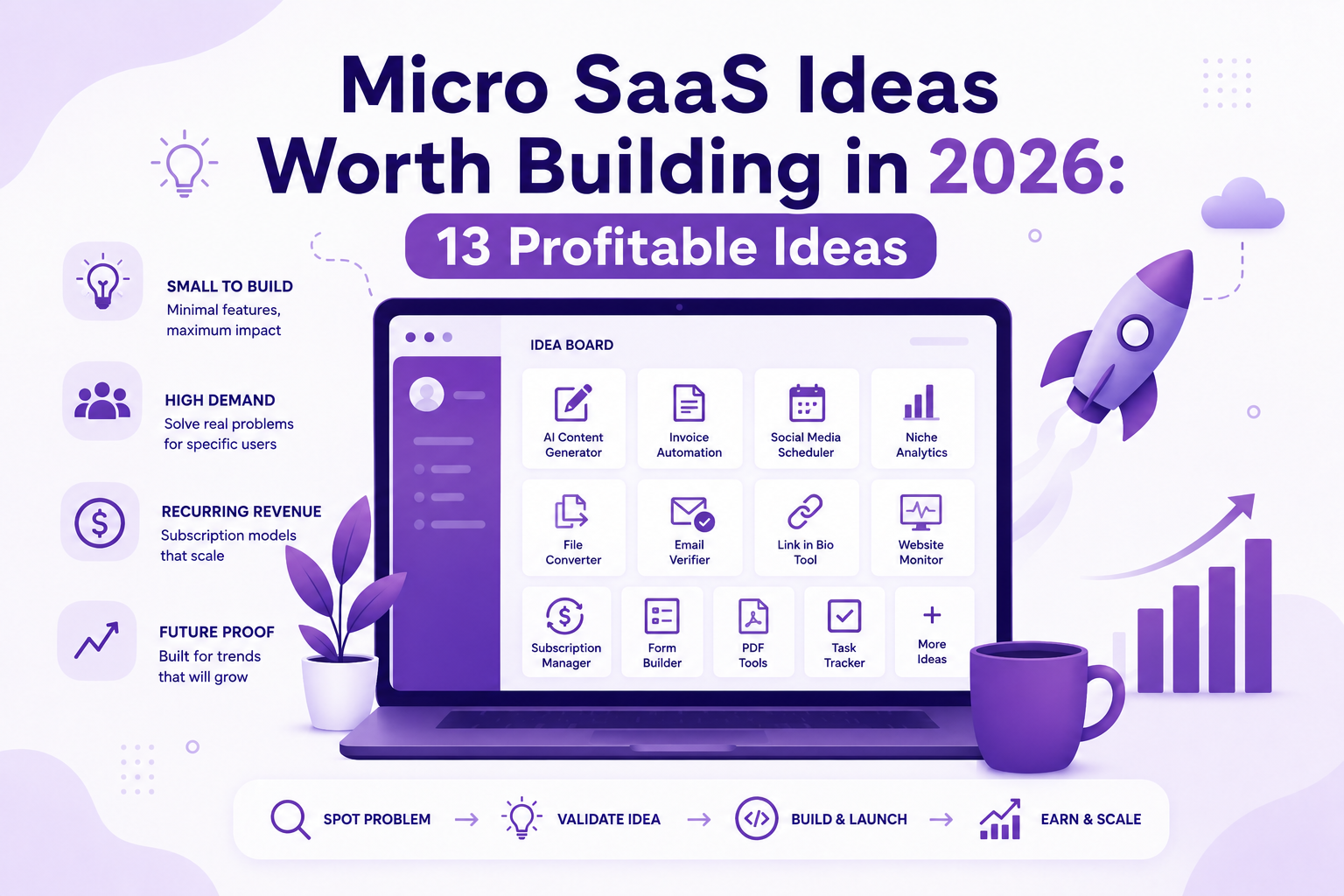
The idea of building a software business can sound intimidating.
You may think you need a large development team, expensive servers, millions of users, and years of development before you can make money from software.
But that is not necessarily true.
The rise of Micro SaaS has created another path.
Instead of building a massive software platform with hundreds of features, you can build a small, focused application that solves one specific problem for a well defined group of people.
And in 2026, there are more opportunities than ever.
Businesses are increasingly looking for ways to automate repetitive tasks, use artificial intelligence, analyze data, improve their online presence, manage customers, and reduce operational costs.
That means there are thousands of problems that could potentially become profitable software products.
The challenge is not finding something to build.
The challenge is finding a problem that is painful enough to solve, specific enough to target, and valuable enough for people to pay for.
So, what Micro SaaS ideas are worth considering in 2026?
Let's explore some practical opportunities.
What Makes a Good Micro SaaS Idea?
Before looking at specific ideas, it is important to understand what makes an idea worth building.
A good Micro SaaS product should ideally solve a real problem rather than simply provide another "cool" feature.
Look for problems that are:
- Repetitive
- Time consuming
- Expensive
- Difficult to manage manually
- Currently solved with spreadsheets
- Currently solved with multiple disconnected tools
- Important enough that businesses are willing to pay for a solution
The best opportunities are often hidden inside boring business processes.
If someone is spending five hours every week doing something manually, there may be an opportunity to build software that does it in five minutes.
That is where Micro SaaS becomes interesting.
1. AI Content Repurposing Tool
Content creators and businesses are producing more content than ever.
A single podcast, webinar, YouTube video, or long form article can contain enough information to create dozens of smaller pieces of content.
The problem is that manually transforming one piece of content into:
- LinkedIn posts
- Facebook posts
- X posts
- Blog articles
- Email newsletters
- Short video scripts
- Captions
- Quotes
can take hours.
A Micro SaaS product could automate this process.
A user uploads a video transcript or article, selects the platforms they want to target, and the application generates platform specific content.
The key is not simply adding AI.
The opportunity is specialization.
Instead of creating a generic AI writing tool, build one specifically for real estate agents, lawyers, coaches, restaurants, agencies, or another niche.
Why it could work
Businesses already understand the value of content marketing.
If your tool saves them several hours every week, paying a monthly subscription can become an easy business decision.
2. AI Proposal Generator for Freelancers and Agencies
Freelancers and agencies frequently spend time creating proposals for potential clients.
They may need to:
- Understand the client's requirements
- Structure the proposal
- Explain the solution
- Create pricing
- Write deliverables
- Add timelines
- Format the document
- Send it to the client
A Micro SaaS could simplify the process.
The user enters basic information about a project and the application generates a professional proposal based on predefined templates and AI assisted recommendations.
You could even create specialized versions for:
- Web developers
- Digital marketing agencies
- SEO consultants
- Graphic designers
- Video production companies
- Software development agencies
The narrower the niche, the easier it can become to create a product that feels specifically designed for the customer's workflow.
3. Automated Invoice Follow Up Software
Getting clients is one problem.
Getting clients to pay on time is another.
Many freelancers and small businesses still manually send payment reminders.
A Micro SaaS could connect to an invoicing system and automatically send polite reminders when an invoice approaches or passes its due date.
For example:
7 days before payment is due: Friendly reminder.
On the due date: Payment notification.
7 days overdue: Follow up message.
14 days overdue: Stronger payment reminder.
The application could also provide a dashboard showing outstanding invoices and overdue payments.
Why this is interesting
The product is not really selling "invoice reminders."
It is selling less stress and faster cash collection.
That distinction matters when positioning a Micro SaaS product.
4. Niche SEO Keyword Research Tool
SEO is a huge field, but many existing SEO platforms can be overwhelming for beginners and small businesses.
A Micro SaaS could focus on solving one specific SEO problem.
For example:
- Keyword clustering
- Search intent classification
- Local keyword discovery
- Long tail keyword generation
- Content gap analysis
- Internal linking recommendations
- Keyword cannibalization detection
- Competitor content analysis
Instead of trying to compete with large all in one SEO platforms, focus on one problem and make the solution exceptionally simple.
For example:
"Upload your keyword list and automatically group thousands of keywords by search intent."
That is a much more focused product than:
"An all in one SEO platform."
5. Website Audit and Monitoring SaaS
Many businesses have websites but do not regularly monitor their technical health.
A Micro SaaS could automatically check websites for issues such as:
- Broken links
- Slow loading pages
- Missing metadata
- SSL problems
- Mobile usability issues
- Missing images
- Expired certificates
- Basic technical SEO problems
- Website downtime
The platform could send weekly or monthly reports to business owners.
You could even create a white label version for digital agencies that want to provide automated website monitoring to their clients.
This type of product fits naturally into the growing need for website maintenance, SEO, and digital performance monitoring.
6. Social Media Analytics for Small Businesses
Large social media analytics platforms can contain far more functionality than a small business actually needs.
A Micro SaaS could provide a much simpler experience.
For example:
The business connects its social accounts.
The application collects performance data.
At the end of each week or month, it generates a simple report explaining:
- What content performed best
- What content performed poorly
- Engagement trends
- Audience growth
- Best performing content formats
- Recommended content ideas
The key opportunity is simplicity.
The customer does not necessarily want 50 charts.
They want to know:
"What happened, and what should I do next?"
7. AI Customer Support Assistant for Niche Businesses
AI customer support is another large opportunity.
However, instead of building a generic chatbot, consider creating a customer support assistant for one specific industry.
For example:
AI assistant for real estate agencies
AI assistant for hotels
AI assistant for e-commerce stores
AI assistant for schools
AI assistant for clinics
AI assistant for logistics companies
The system could be trained on the company's existing FAQs, policies, services, documents, and knowledge base.
The assistant could answer common questions and escalate complex issues to a human.
The value proposition becomes much clearer when the product understands the specific workflow of a particular industry.
8. Document Processing SaaS
Businesses deal with documents constantly.
Invoices.
Receipts.
Bank statements.
Contracts.
Purchase orders.
Reports.
Applications.
Forms.
A Micro SaaS can take one specific document processing problem and automate it.
For example:
Upload a PDF bank statement → extract transactions → export to CSV or Excel.
Or:
Upload invoices → extract supplier, amount, date, and invoice number → export structured data.
This type of product can be especially valuable when businesses are currently performing the process manually.
The key is to identify a repetitive document workflow where automation can save significant time.
9. Appointment and Reminder SaaS for Specific Industries
Appointment software already exists.
That does not mean there is no opportunity.
The opportunity may be in specialization.
Instead of building another generic appointment booking platform, build one specifically for:
- Beauty salons
- Tutors
- Fitness coaches
- Photographers
- Cleaning companies
- Consultants
- Home service providers
The product could include features specifically relevant to that industry.
For example, a photography booking platform could manage:
- Client enquiries
- Packages
- Deposits
- Event dates
- Contracts
- Reminders
- Follow ups
Specialization can make a familiar product feel significantly more valuable.
10. AI Meeting Summary and Action Tracker
Businesses have meetings every day.
Unfortunately, important tasks can easily disappear after the meeting ends.
A Micro SaaS could take meeting transcripts and automatically identify:
- Decisions
- Action items
- Assigned team members
- Deadlines
- Follow up tasks
- Important discussion points
Instead of simply generating another meeting summary, the product could focus specifically on turning conversations into accountable tasks.
That creates a much clearer business value proposition.
11. Simple CRM for a Specific Niche
Customer relationship management software is a huge market.
But many small businesses find traditional CRM platforms unnecessarily complicated.
A Micro SaaS could build a CRM specifically for one profession.
For example:
CRM for real estate agents
CRM for recruitment consultants
CRM for wedding photographers
CRM for freelance developers
CRM for marketing agencies
The interface could contain only the features that the target customer actually needs.
Instead of asking users to configure hundreds of settings, the application could work almost immediately after signup.
12. Local Business Review Management Tool
Online reviews can significantly influence how customers perceive local businesses.
Yet many business owners do not consistently monitor or respond to reviews.
A Micro SaaS could help businesses:
- Monitor new reviews
- Receive notifications
- Generate response suggestions
- Track ratings
- Identify recurring complaints
- Monitor review trends
- Request reviews from customers
Again, the opportunity is not necessarily in creating a complicated platform.
It is in making one important business process easier.
13. Website Lead Capture and Follow Up Tool
A business can receive website visitors without generating enough leads.
A Micro SaaS could focus specifically on turning website visitors into enquiries.
For example, the platform could provide:
- Smart contact forms
- Lead qualification
- Automated email responses
- WhatsApp notifications
- Lead scoring
- Follow up reminders
- Simple analytics
The business owner could receive a notification whenever a high quality lead submits a form.
The product would essentially help businesses answer one question:
"How do I turn more of my website visitors into potential customers?"
How to Choose the Right Micro SaaS Idea
Having 20 ideas is not necessarily better than having one good idea.
The important question is:
Which problem should you solve first?
Before building anything, evaluate your idea using these questions.
Is the problem real?
Talk to potential users.
Do not assume that a problem exists simply because you think it should.
Is the problem painful?
People are more likely to pay for software that removes a significant frustration, saves time, reduces costs, or increases revenue.
Are people already paying for a solution?
Competition is not always a bad thing.
If businesses are already paying for solutions, that can be evidence that the problem has commercial value.
Your opportunity may be to make the solution:
- Simpler
- Cheaper
- Faster
- More specialized
- Easier to use
- Better suited to a specific market
Can you reach the customers?
A brilliant product is difficult to monetize if you have no practical way to reach potential users.
Think about where your customers spend time.
That could be:
- Facebook groups
- YouTube
- Industry communities
- Search engines
- Local business networks
- Email communities
Distribution is just as important as development.
Build the MVP Before Building the Empire
One of the biggest mistakes first time Micro SaaS founders make is building too much.
They create user authentication.
Dashboards.
Admin panels.
Mobile applications.
AI integrations.
Payment systems.
Analytics.
Dozens of settings.
And six months later, they still have no customers.
Do not make the product bigger than the problem.
Start with the smallest version that can deliver the promised result.
If the problem is:
"Businesses waste hours manually extracting transactions from PDF bank statements."
Your MVP does not need 50 features.
It may simply need:
Upload PDF → Extract transactions → Download CSV.
If customers love it, you can build from there.
The Real Opportunity in Micro SaaS
The most exciting thing about Micro SaaS is not that you can build a small application.
It is that small problems can become real businesses.
A product does not need millions of users to become valuable.
If you have 100 customers paying $20 per month, that is $2,000 in monthly recurring revenue.
At 500 customers, it becomes $10,000 per month.
At 1,000 customers, it becomes $20,000 per month.
Of course, getting and retaining those customers is the difficult part.
But this demonstrates the fundamental Micro SaaS model:
Find a valuable problem → Build a focused solution → Acquire customers → Deliver value → Retain customers → Improve the product → Scale.
Final Thoughts
The best Micro SaaS idea in 2026 may not be the most complicated one.
It may be the tool that solves a frustrating problem that thousands of people encounter every week.
Look around you.
What are businesses doing manually?
What are people repeatedly copying and pasting?
What tasks are still being managed through spreadsheets?
What processes require unnecessary emails?
What software do people complain about?
What tasks consume hours that could be automated?
Those questions can lead you to better Micro SaaS opportunities than simply asking:
"What app can I build?"
Technology gives you the ability to build almost anything.
But successful Micro SaaS businesses are not created by technology alone.
They are created by solving the right problem for the right people in a way they are willing to pay for.
If you have a Micro SaaS idea and need help turning the concept into a functional software product, Zeecomedia's web application development services can help you move from idea and MVP to a production ready application.
And once your application is live, Zeecomedia's maintenance and support services can help keep your platform secure, updated, optimized, and reliable.
Your next software business does not have to start with a million users.
It can start with one problem, one solution, and one paying customer.