Micro SaaS vs Full SaaS: Key Differences, Costs, and Which to Build
September 1, 2026 · 12 min read
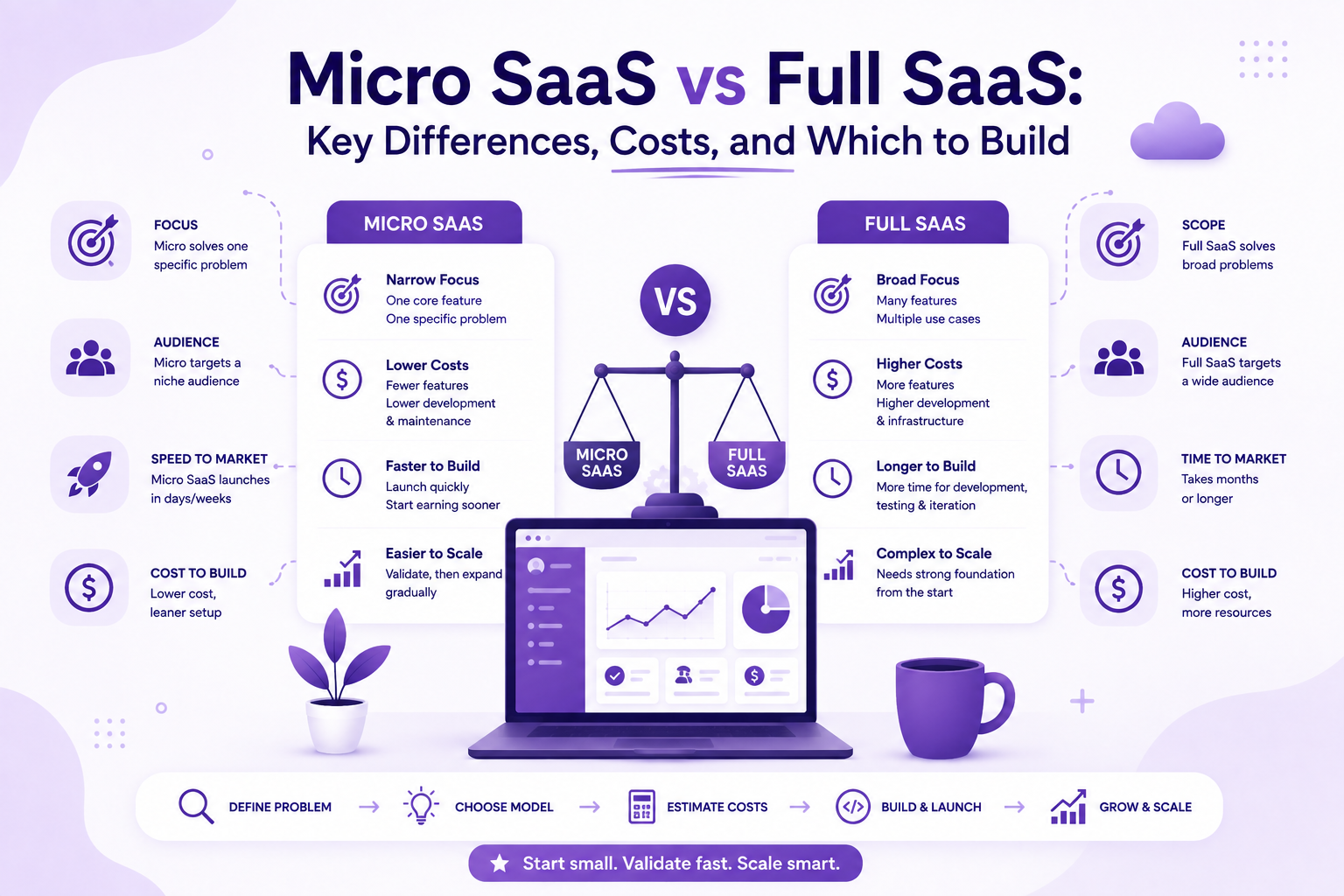
If you are thinking about building a software business, you have probably come across the term SaaS.
You may also have heard people talking about Micro SaaS.
At first, they can sound like the same thing.
After all, both involve building software that customers access through the internet, often through a subscription model.
But there is an important difference.
Micro SaaS is essentially a smaller, more focused approach to building a SaaS business.
While a traditional or "Full SaaS" product may attempt to serve a broad market with a large range of features, a Micro SaaS product typically focuses on solving one specific problem for a well defined niche.
So, which one should you build?
Should you create a small Micro SaaS product that can potentially be managed by one person or a small team?
Or should you aim for a larger SaaS platform with more features, customers, and growth potential?
Let's break down the key differences.
What Is SaaS?
SaaS, or Software as a Service, is a software distribution model where customers access an application over the internet rather than installing and maintaining the software entirely on their own devices.
Examples of SaaS products include software for:
- Project management
- Customer relationship management
- Accounting
- Email marketing
- Human resources
- Communication
- Analytics
- E-commerce
- Collaboration
Customers typically access these platforms through a web browser or mobile application and may pay monthly or annual subscription fees.
The SaaS model allows software companies to generate recurring revenue while continuously providing updates, maintenance, support, and new functionality.
Traditional SaaS companies can range from small startups to massive global technology companies.
What Is Micro SaaS?
Micro SaaS is a smaller, highly focused SaaS business designed around a specific problem, niche, or workflow.
A Micro SaaS product may be built and operated by a solo founder or a small team.
Instead of trying to solve many problems for a huge audience, it usually focuses on doing one thing particularly well.
For example, instead of building a massive marketing platform, a Micro SaaS could focus specifically on:
Automatically generating SEO reports for small agencies.
Instead of building a complete accounting platform, it could focus on:
Converting financial documents into structured data.
Instead of building a complete CRM, it could focus on:
Helping real estate agents automatically follow up with leads.
The product is smaller in scope, but that does not mean it is less valuable.
The value comes from solving a specific problem effectively.
Micro SaaS vs Full SaaS: The Key Differences
Although both models use software to solve customer problems, they differ significantly in their scope, target market, development requirements, operations, and growth strategy.
1. Product Scope
The first major difference is the size and complexity of the product.
A traditional SaaS platform may contain dozens or even hundreds of features.
It could include:
- Advanced dashboards
- Multiple user roles
- Integrations
- Reporting
- Automation
- APIs
- Mobile applications
- Collaboration tools
- Advanced analytics
- Custom workflows
A Micro SaaS product generally has a much narrower scope.
It may focus on one primary workflow.
For example:
Full SaaS: Complete marketing automation platform.
Micro SaaS: Automatically turns blog articles into social media posts.
The Micro SaaS product does less, but it solves one problem more directly.
2. Target Audience
Full SaaS products often target a broad market.
A project management platform, for example, could target startups, agencies, corporations, freelancers, schools, and many other organizations.
Micro SaaS businesses often take the opposite approach.
They may target one specific audience.
For example:
"Project management software for wedding photographers."
"CRM software for independent real estate agents."
"Invoice automation for freelance developers."
"SEO reporting software for small marketing agencies."
This narrow positioning can make marketing much easier because the business has a clearly defined customer.
3. Development Time
A larger SaaS product can take considerable time to build because of its feature set, infrastructure requirements, integrations, testing, security requirements, and user management systems.
A Micro SaaS product can often reach its first usable version much faster because the scope is intentionally limited.
This makes the Micro SaaS model particularly attractive to developers and entrepreneurs who want to validate an idea before making a major investment.
Instead of spending a year building a platform and then discovering that nobody wants it, you can build a smaller MVP and put it in front of potential customers.
4. Development Cost
The larger the software product, the more resources are generally required to develop and operate it.
A Full SaaS business may require:
- Multiple developers
- UI and UX designers
- Product managers
- DevOps engineers
- Customer support
- Marketing teams
- Sales teams
- Security specialists
A Micro SaaS can potentially be operated by one developer or a small team.
Modern technologies have also reduced the barrier to entry.
Cloud hosting, managed databases, payment APIs, AI APIs, authentication services, analytics tools, automation platforms, and other developer services allow small teams to build products that would have required significantly more infrastructure in the past.
That does not mean Micro SaaS is free to build.
It simply means the initial operational requirements can be considerably smaller.
5. Team Size
This is another major difference.
A Full SaaS company usually requires a growing team as the product and customer base expand.
Different departments may eventually handle:
- Product development
- Engineering
- Customer support
- Marketing
- Sales
- Finance
- Operations
- Security
Micro SaaS businesses are often designed around a leaner structure.
One person may handle:
- Development
- Product management
- Marketing
- Customer support
- Infrastructure
- Business operations
Of course, not every Micro SaaS founder works alone.
A small team can still provide significant advantages while maintaining a relatively lean operation.
6. Customer Acquisition
Full SaaS companies often invest heavily in customer acquisition.
They may use:
- Paid advertising
- Sales teams
- Content marketing
- SEO
- Partnerships
- Affiliate marketing
- Events
- Enterprise sales
- Outbound prospecting
Micro SaaS businesses may rely more heavily on focused distribution.
For example, if your product is designed for freelance developers, you could reach them through developer communities, LinkedIn, YouTube, newsletters, online communities, or content marketing.
A narrow audience can make your marketing message more specific.
Instead of saying:
"Our platform helps businesses manage their workflows."
You could say:
"Automatically track and follow up with every property lead without manually updating your CRM."
Specific messaging can be easier for the right customer to understand.
7. Feature Complexity
Feature creep is one of the biggest dangers when building software.
A Full SaaS company may continuously add features because different customer segments have different requirements.
This can eventually create a complicated product.
Micro SaaS businesses often benefit from staying focused.
If a feature does not directly contribute to the product's core value, it may not need to be built.
This creates a useful question for Micro SaaS founders:
"Does this feature solve the customer's primary problem?"
If the answer is no, it may belong on the backlog rather than inside the MVP.
8. Revenue Potential
This is where things become interesting.
A Full SaaS platform generally has the potential to serve a much larger market.
That means its revenue ceiling can potentially be very high.
A successful SaaS company could have:
10,000 customers
100,000 customers
or even millions of users.
Micro SaaS businesses operate on a smaller scale.
But smaller does not mean unprofitable.
Imagine a Micro SaaS product charging $25 per month.
100 customers would generate:
$2,500 in monthly recurring revenue.
500 customers would generate:
$12,500 in monthly recurring revenue.
1,000 customers would generate:
$25,000 in monthly recurring revenue.
The challenge is acquiring and retaining those customers.
But the example demonstrates why a relatively small customer base can still support a meaningful software business.
9. Operational Complexity
Full SaaS platforms can become increasingly complex as they scale.
More customers can mean:
- More infrastructure
- More support requests
- More security requirements
- More integrations
- More data
- More operational processes
- More employees
- More compliance requirements
Micro SaaS businesses can remain considerably leaner.
Automation can handle many repetitive tasks, including:
- Customer onboarding
- Billing
- Email notifications
- Reporting
- Support triage
- Data processing
- Monitoring
The objective is to build a business that does not require constant manual intervention.
10. Speed of Experimentation
A major advantage of Micro SaaS is the ability to experiment quickly.
If you have a small team, you can potentially change your product, pricing, onboarding process, or marketing strategy without going through multiple layers of organizational approval.
You can:
Build → Launch → Measure → Learn → Improve.
That feedback loop can be extremely valuable.
A larger SaaS company may have more resources, but organizational complexity can make experimentation slower.
Micro SaaS vs Full SaaS Comparison
| Factor | Micro SaaS | Full SaaS | | ---------------- | ---------------------------------- | ----------------------------------- | | Product scope | Narrow and focused | Broad and feature rich | | Target audience | Specific niche | Broad market | | Development time | Usually shorter | Usually longer | | Initial cost | Generally lower | Generally higher | | Team size | Solo founder or small team | Larger team | | Feature count | Limited | Extensive | | Customer base | Smaller, niche focused | Potentially very large | | Operations | Lean | More complex | | Marketing | Highly targeted | Broad and multi channel | | Growth potential | Smaller but potentially profitable | Potentially very large | | Experimentation | Usually faster | Can be slower | | Management | Can be founder led | Often requires multiple departments |
Which One Should You Build?
There is no universal answer.
The right model depends on your goals, resources, experience, market, and risk tolerance.
Choose Micro SaaS If...
Micro SaaS may be a better option if:
- You are a solo developer
- You have limited startup capital
- You have identified a specific problem
- You understand a particular niche
- You want to launch quickly
- You want to validate an idea before investing heavily
- You prefer a lean business
- You want to keep operational complexity low
Micro SaaS can be particularly attractive for developers who already have technical skills and want to turn those skills into a product based business.
Choose Full SaaS If...
A larger SaaS model may make more sense if:
- You are targeting a large market
- The problem requires multiple features
- You have significant funding
- You have a larger development team
- You need enterprise functionality
- You have a strong sales and marketing strategy
- You are pursuing aggressive growth
- The market opportunity is large enough to justify the additional complexity
The important thing is not to choose the bigger model simply because it sounds more impressive.
Build according to the problem.
Can a Micro SaaS Become a Full SaaS?
Absolutely.
In fact, this can be one of the smartest ways to approach software development.
You can start with a small product that solves one specific problem.
Once you have paying customers and understand their needs, you can gradually expand.
For example:
Stage 1: Solve one problem.
Stage 2: Acquire your first customers.
Stage 3: Improve the core product.
Stage 4: Add features customers actually request.
Stage 5: Expand into related workflows.
Stage 6: Enter adjacent markets.
Over time, a Micro SaaS can evolve into a much larger SaaS platform.
The important part is that expansion should be driven by customer demand, not simply by the desire to make the product bigger.
The Biggest Mistake: Building Too Much Too Early
One of the biggest mistakes aspiring SaaS founders make is trying to build the complete vision immediately.
They imagine the final product and attempt to build everything at once.
That can result in:
- Long development cycles
- High costs
- Complicated code
- Feature overload
- Delayed launches
- Little customer feedback
- Increased risk
Instead, start with the smallest practical version.
Ask:
What is the one problem my customer desperately wants solved?
Build that first.
Once people use it and demonstrate that they are willing to pay for it, you have evidence that you are moving in the right direction.
Final Thoughts
Micro SaaS and Full SaaS are not necessarily competing business models.
They are different approaches to building software businesses.
Full SaaS focuses on breadth, scale, and serving larger markets.
Micro SaaS focuses on simplicity, specialization, and solving a specific problem for a specific audience.
If you are a developer or entrepreneur with limited resources, Micro SaaS can provide a practical way to enter the software business without trying to build a massive platform from day one.
You do not need thousands of customers before your product becomes meaningful.
You need to solve a problem that people care about.
You need to reach the right customers.
And most importantly, you need to create enough value that they are willing to keep paying for the solution.
Start With the Problem, Not the Technology
Whether you decide to build a Micro SaaS or a larger SaaS platform, the principle remains the same:
Do not start by asking what technology you can build.
Start by asking:
What problem can I solve?
Then determine the simplest software solution that can solve it.
If you already have a SaaS or Micro SaaS idea and need help turning it into a functional product, Zeecomedia's web application development services can help you move from an idea or MVP to a production ready web application.
And after your application goes live, Zeecomedia's maintenance and support services can help with ongoing updates, technical improvements, optimization, monitoring, and support.
Your next software business does not have to start as a massive platform.
Start small. Solve something valuable. Listen to your customers. Then scale.