MVP Development Services: What to Expect When You Hire One
September 8, 2026 · 11 min read
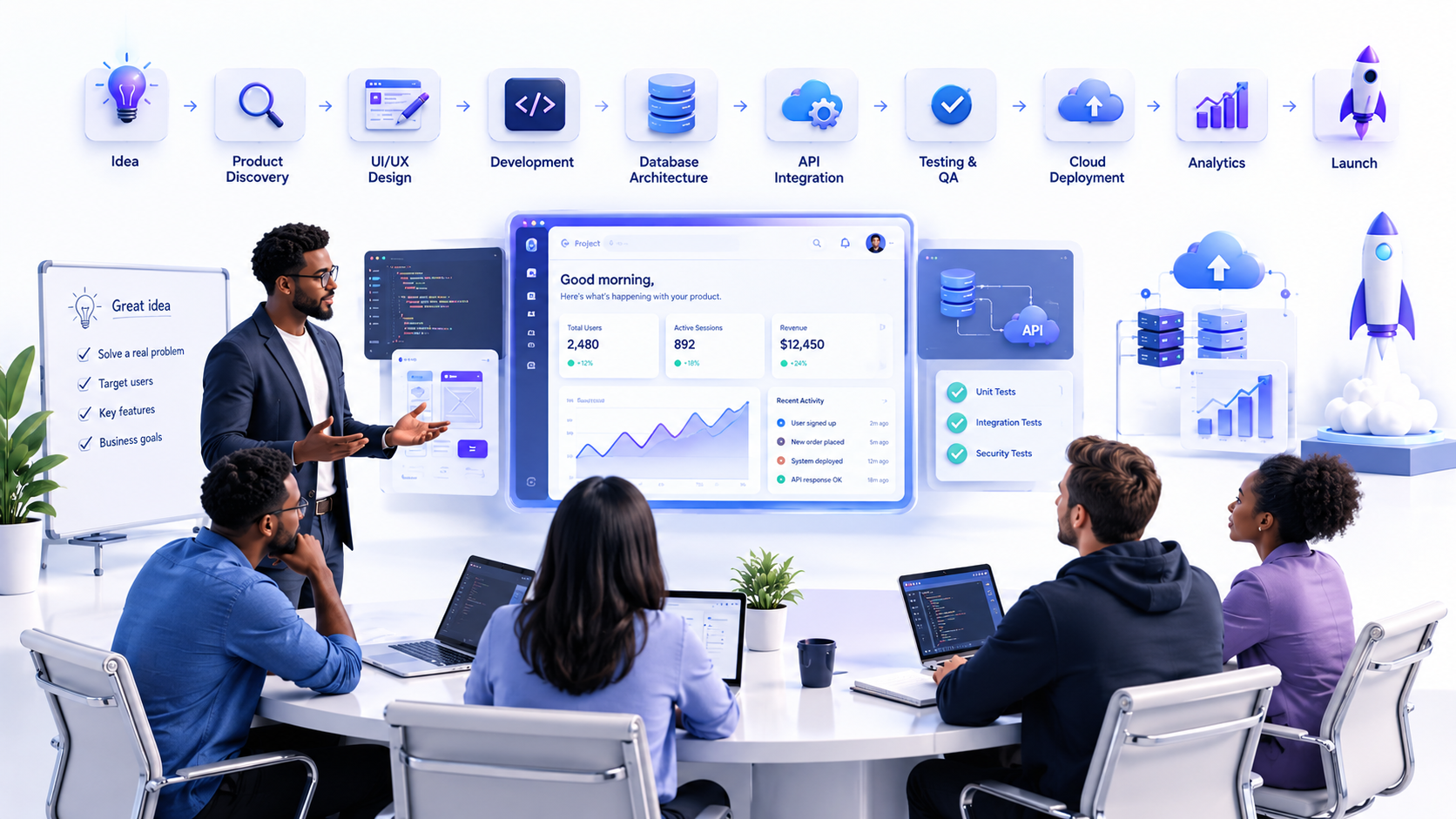
You have a SaaS idea.
You have identified a problem worth solving.
You may even have a list of features you want to build.
But there is one major question:
How do you turn the idea into a real product without spending a fortune before knowing whether people will actually use it?
This is where MVP development services come in.
A Minimum Viable Product, commonly called an MVP, allows businesses and startups to build the core version of a product, launch it to real users, collect feedback, and validate the idea before investing heavily in a complete application.
However, hiring an MVP development company does not simply mean handing over your idea and receiving software a few weeks later.
A professional development partner should guide you through product discovery, feature prioritization, design, development, testing, deployment, and sometimes post launch support.
So, what should you actually expect when you hire an MVP development service?
Let's explore it.
What Is MVP Development?
MVP development is the process of creating the simplest functional version of a product that solves a specific problem for a specific group of users.
The goal is not to build an incomplete or poor quality application.
The goal is to build the right product with only the essential features needed to test the business idea.
For example, imagine you want to build a SaaS platform that helps small businesses manage invoices.
Your long term product might eventually include:
- Automated invoicing
- Payment reminders
- Accounting integrations
- Expense tracking
- Financial reports
- Team management
- Mobile applications
- AI powered financial insights
Building everything at once could require significant time and money.
An MVP might initially focus on:
- User registration
- Creating invoices
- Sending invoices
- Tracking payment status
- Basic customer management
Once real customers start using the product, you can determine which additional features are actually worth building.
Why Businesses Hire MVP Development Services
The biggest advantage of working with an MVP development company is that you can potentially reduce the risk associated with building a new product.
Instead of asking:
"Can we build this?"
you can start asking:
"Do customers actually want this?"
A well planned MVP can help you:
- Validate your idea
- Test market demand
- Get early customers
- Collect user feedback
- Identify important features
- Attract investors
- Reduce unnecessary development costs
- Establish a foundation for future development
Your MVP becomes a learning tool, not just a software product.
What to Expect When You Hire an MVP Development Company
Hiring an MVP development service should involve much more than coding.
Here is what a typical engagement can look like.
1. Initial Discovery and Consultation
The process usually starts with a conversation about your idea.
The development team should want to understand:
- What problem are you solving?
- Who are your target users?
- What does the existing market look like?
- What makes your product different?
- What features are essential?
- What is your business model?
- What are your long term goals?
This stage is important because developers cannot build the right product if they do not understand the problem behind it.
A good development partner may also challenge some of your assumptions.
That is a good thing.
You do not want a company that simply says yes to every feature you request.
You want a partner that can help you determine what actually belongs in the MVP.
2. Feature Prioritization
One of the most important parts of MVP development is deciding what not to build.
This can be surprisingly difficult.
Founders often have dozens of ideas for their products.
The problem is that every additional feature can increase:
- Development time
- Development cost
- Testing requirements
- Maintenance requirements
- User complexity
Your MVP development company should help categorize features based on importance.
For example:
Must have
Features required for the product to solve its core problem.
Should have
Useful features that can potentially be added after validation.
Nice to have
Features that can wait until the product gains traction.
This process keeps the MVP focused.
3. Product and Technical Planning
Once the MVP scope is defined, the development team can create a technical roadmap.
This may include decisions about:
- Frontend technology
- Backend architecture
- Database
- APIs
- Authentication
- Hosting
- Third party integrations
- Payment processing
- Security
- Deployment
The team should also consider how the application can evolve after the MVP stage.
You do not need to build a massive infrastructure from day one.
But you also do not want an architecture that makes future growth unnecessarily difficult.
4. UI/UX Design
Your MVP still needs to be easy to use.
MVP does not mean "make it ugly."
A confusing interface can prevent users from understanding the value of your product.
During the design phase, the team may create:
- User flows
- Wireframes
- Prototypes
- Dashboard layouts
- Mobile responsive designs
- Navigation structures
- Design systems
The objective is to create an experience that allows users to accomplish their goals with minimal friction.
5. MVP Development
Once the requirements and designs are approved, development begins.
Depending on the product, this could involve frontend development, backend development, database development, API integration, authentication, payment systems, admin dashboards, and other functionality.
The technology stack will depend on your requirements.
For example, a SaaS MVP could potentially use technologies such as:
- React
- Next.js
- Python
- Django
- Node.js
- PostgreSQL
- Redis
- Docker
- AWS
The important thing is not using the most fashionable technology.
The important thing is choosing an appropriate stack for the product.
6. Testing and Quality Assurance
Before your MVP reaches users, it needs to be tested.
Quality assurance can identify problems such as:
- Broken features
- Authentication issues
- Database errors
- Payment problems
- Poor mobile responsiveness
- API failures
- Security vulnerabilities
- Performance issues
A professional MVP development company should not treat testing as an optional final step.
Testing should happen throughout the development process.
7. Deployment
Once the MVP is ready, it needs to be deployed to a production environment.
This may involve:
- Cloud infrastructure
- Domain configuration
- SSL certificates
- Database deployment
- Environment variables
- Application monitoring
- Backup systems
- Production configuration
The development team should make sure your product is ready for real users rather than simply working on a developer's computer.
8. Launch and User Feedback
This is where MVP development becomes particularly valuable.
You finally have real users interacting with the product.
Their behavior can reveal things that assumptions and meetings cannot.
Users may tell you:
"This feature is confusing."
"I don't understand this button."
"I really need this integration."
"I would pay for this."
"I don't need this feature."
That feedback becomes valuable data for your next development cycle.
9. Post Launch Improvements
Your MVP should not necessarily be the final version of your product.
After launch, you can use customer feedback and analytics to determine what should happen next.
You may discover that:
- Users love one particular feature.
- Another feature is rarely used.
- Customers want an integration you did not initially consider.
- The onboarding process needs improvement.
- Certain users are willing to pay more for advanced functionality.
Your product roadmap can then evolve based on evidence.
How Much Do MVP Development Services Cost?
There is no universal MVP development price.
The cost depends on the complexity of the product.
Factors that can influence the price include:
- Number of features
- UI/UX complexity
- Backend architecture
- Number of user roles
- Third party integrations
- Payment processing
- AI functionality
- Security requirements
- Mobile requirements
- Cloud infrastructure
- Development timeline
A simple MVP can be relatively affordable compared with a complex enterprise platform.
The key is to control scope.
The more features you add, the further you move away from a lean MVP.
Fixed Price vs Dedicated Development Team
MVP development companies may offer different engagement models.
Fixed Price
You agree on a defined scope and price.
This can work well when your requirements are clearly defined.
Hourly Development
You pay based on the development hours used.
This can provide greater flexibility when requirements are likely to evolve.
Dedicated Development Team
You work with a dedicated team over a period of time.
This can be useful for startups that expect continuous development beyond the initial MVP.
The best model depends on your product, budget, scope, and development strategy.
How Long Does MVP Development Take?
There is no universal timeline.
A simple MVP might take several weeks, while a more complex SaaS product can take several months.
The timeline depends on:
- Product complexity
- Number of features
- Design requirements
- Integrations
- Development team size
- Testing requirements
- Client feedback cycles
Be cautious of companies promising to build a sophisticated SaaS platform in an unrealistically short period.
Speed is valuable.
But rushing development can create technical debt and quality problems.
How to Choose an MVP Development Company
Before hiring an MVP development partner, investigate their:
Portfolio
Look for previous products that demonstrate relevant experience.
Technical expertise
Make sure they understand the technologies required for your project.
Communication
You should know how often you will receive updates and how feedback will be handled.
Development process
Ask how they handle discovery, design, development, testing, deployment, and maintenance.
Security
Understand how they protect application and customer data.
Scalability
Ask how the MVP can evolve as your customer base grows.
Post launch support
Find out whether they provide maintenance and future development.
Red Flags to Watch Out For
Be cautious if an MVP development company:
- Promises unrealistic timelines
- Gives an extremely low quote without defining the scope
- Has no relevant portfolio
- Avoids discussing security
- Cannot explain its development process
- Wants to build dozens of features immediately
- Does not clarify source code ownership
- Provides vague contracts
- Offers no post launch support
The right development partner should help reduce your product risk, not increase it.
MVP Development Is About Validation, Not Just Software
One of the biggest misconceptions about MVP development is that the objective is simply to build a smaller version of the final product.
That is not the real purpose.
The real objective is validation.
You want to discover whether your target users have the problem you think they have, whether your solution actually helps them, and whether they are willing to use or pay for it.
That means your MVP should be designed around learning.
Build.
Launch.
Measure.
Learn.
Improve.
Repeat.
This approach can help you avoid spending significant resources building features that customers never use.
Ready to Turn Your Idea Into an MVP?
A great SaaS idea deserves more than a developer who simply starts writing code.
You need a development partner who can help you translate the idea into a focused product, prioritize the right features, choose an appropriate technology stack, build the application, test it, launch it, and prepare it for future growth.
At Zeecomedia, we help businesses and startups turn software ideas into functional web applications and SaaS products.
Whether you are starting with an idea, planning your first MVP, or looking to transform an existing concept into a scalable product, we can help you approach development with a clear strategy.
Ready to discuss your MVP?
Talk to Zeecomedia about your project
You can also explore Zeecomedia's software development solutions to see how we can help turn your digital product idea into reality.
Frequently Asked Questions
What is MVP development?
MVP development is the process of building the essential version of a product with enough functionality to solve a specific user problem and validate the business idea with real users.
How much does it cost to develop an MVP?
MVP development costs vary depending on features, complexity, technology, integrations, design, security, and development requirements.
How long does it take to build an MVP?
A simple MVP can potentially be developed within several weeks, while more complex SaaS MVPs may require several months.
Is an MVP a low quality product?
No. An MVP should be focused rather than poorly built. It should provide enough functionality to solve the core problem while avoiding unnecessary features.
Should I build an MVP for my SaaS idea?
If you are uncertain about market demand, an MVP can be an effective way to test your idea with real users before investing heavily in the full product.
What happens after an MVP launches?
After launch, you can analyze user behavior, collect feedback, identify valuable features, fix problems, and gradually develop the product based on what you learn.
Final Thoughts
Hiring an MVP development company should not be viewed as simply outsourcing software development.
You are bringing in a technical partner to help turn an idea into something that real people can use and evaluate.
The right partner should help you define the MVP, prioritize features, design the user experience, choose the appropriate technology, build the product, test it, launch it, and improve it based on real world feedback.
The goal is simple:
Build enough to learn, launch enough to validate, and improve enough to grow.
If you have a SaaS or software idea that you want to validate, the next step is not necessarily building everything.
Start with the right MVP.