SaaS MVP Development: A Practical Guide to Building Your First SaaS
September 2, 2026 · 13 min read
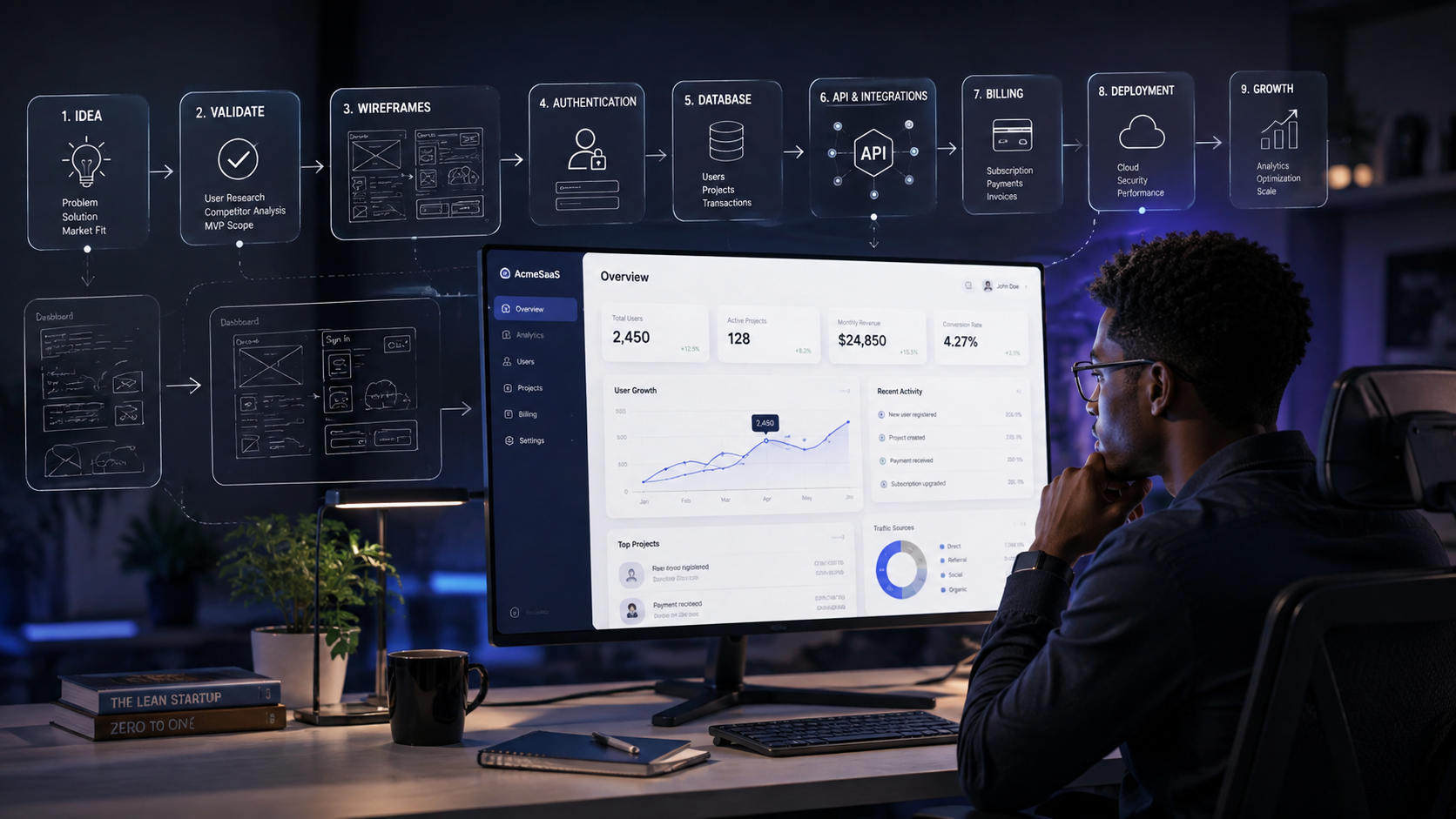
Have you ever had a SaaS idea that sounded like a great business, only to become overwhelmed by everything you thought you needed to build?
User registration.
Dashboards.
Payment systems.
Mobile apps.
AI integrations.
Notifications.
Analytics.
Admin panels.
Third party integrations.
Before you know it, your simple idea has turned into a massive software project that could take months or even years to complete.
This is one of the biggest mistakes aspiring SaaS founders make.
They try to build the finished product before proving that people actually want it.
That is where SaaS MVP development comes in.
An MVP, or Minimum Viable Product, allows you to build the simplest functional version of your SaaS idea, put it in front of real users, collect feedback, and determine whether there is enough demand to continue investing in the product.
The objective is not to build a perfect application.
The objective is to validate the idea with the smallest reasonable investment.
In this guide, we will explain what a SaaS MVP is, why it matters, what features you should include, how to develop one, common mistakes to avoid, and how to move from an MVP to a scalable SaaS product.
What Is a SaaS MVP?
A SaaS MVP is the first usable version of a Software as a Service product that contains only the essential functionality required to solve a specific customer problem.
The key word is essential.
Your MVP should provide enough functionality for a real user to experience the primary value of your product.
For example, imagine you want to build a SaaS platform that helps businesses convert PDF bank statements into structured Excel or CSV files.
You may eventually want to add:
- Team accounts
- Advanced analytics
- API access
- Automated workflows
- Cloud storage
- Multiple export formats
- Accounting integrations
- AI categorization
- Mobile applications
But none of those features may be necessary for your first version.
Your MVP might simply need:
Upload PDF → Process document → Extract transactions → Download CSV.
If customers are willing to use and pay for that solution, you have validated an important part of your business idea.
You can then build additional functionality based on actual customer demand.
Why Is MVP Development Important for SaaS?
Building software requires time, money, and technical resources.
If you build a large product before validating the market, you take on unnecessary risk.
An MVP reduces that risk.
1. It Helps You Validate Your Idea
The most important question for any SaaS founder is not:
"Can I build this?"
It is:
"Will people use and pay for this?"
Technical feasibility does not automatically mean commercial viability.
You may be able to build an impressive application that nobody actually needs.
An MVP allows you to test your assumptions with real users.
2. It Reduces Development Costs
The more features you build, the more development time and infrastructure you need.
By focusing on the core problem, you can reduce the initial investment required to launch.
This is particularly useful for solo founders, startups, freelancers, and small businesses working with limited budgets.
3. It Allows You to Launch Faster
Speed matters when validating a software idea.
The faster you can put a working product in front of customers, the faster you can learn.
Instead of spending twelve months building in isolation, you can potentially launch an initial version much sooner and use customer feedback to guide development.
4. It Provides Real Customer Feedback
You can make assumptions about what customers want.
Your customers may have completely different priorities.
A feature you believed was essential might barely be used.
Another feature you considered secondary could turn out to be the reason customers are willing to pay.
An MVP gives you real usage data instead of relying entirely on assumptions.
5. It Reduces the Risk of Overbuilding
Feature creep can destroy SaaS projects.
Every additional feature introduces:
- Development time
- Testing requirements
- Maintenance
- Security considerations
- User interface complexity
- Support requirements
A focused MVP keeps the product manageable.
MVP vs Prototype: What Is the Difference?
These terms are often confused.
A prototype is generally used to demonstrate how a product could work.
It may consist of:
- Wireframes
- Clickable designs
- Mockups
- Interactive prototypes
- Concept demonstrations
A prototype may not contain a functioning backend or real production infrastructure.
An MVP, on the other hand, is a functional product that real users can actually use to solve a real problem.
For example:
A Figma design showing a SaaS dashboard is a prototype.
A deployed SaaS application where users can register, upload data, process it, and receive an actual result is an MVP.
The prototype helps communicate the idea.
The MVP helps validate the business.
What Features Should a SaaS MVP Have?
There is no universal feature list because every SaaS product is different.
However, most SaaS MVPs will need some basic components.
User Authentication
Depending on your product, users may need to:
- Create an account
- Log in
- Reset their password
- Manage their profile
However, authentication should remain as simple as possible during the MVP stage.
Core Product Functionality
This is the most important part.
Ask:
What is the primary problem my SaaS solves?
Then build the functionality required to solve that problem.
Everything else should be questioned.
Basic Dashboard
Users usually need somewhere to view their activity, results, files, projects, or account information.
The dashboard does not need to contain every possible metric.
It simply needs to help users interact with the core product.
Payment System
If your MVP is intended to generate revenue immediately, you may need a payment system.
Depending on your target market, this could involve payment providers that support:
- Subscriptions
- One time payments
- Usage based billing
- Payment verification
- Invoices
Do not build a complicated billing architecture if a reliable payment provider can handle the majority of the complexity.
Basic Analytics
You need to understand how users interact with the product.
Track useful events such as:
- Signups
- Logins
- Feature usage
- Trial activation
- Subscription conversion
- Cancellations
- Errors
You do not need hundreds of metrics.
Focus on information that helps you make product decisions.
How to Build a SaaS MVP Step by Step
Now let's look at a practical SaaS MVP development process.
Step 1: Define the Problem
Before choosing a programming language or framework, define the problem.
Write down:
Who has the problem?
What exactly is the problem?
How are they currently solving it?
Why is the existing solution inadequate?
What would make them pay for a better solution?
If you cannot clearly explain the problem, you probably should not start development yet.
Step 2: Define Your Target Customer
Avoid targeting everyone.
A specific customer profile makes product development and marketing much easier.
Instead of:
"Our SaaS is for businesses."
Consider:
"Our SaaS helps small digital marketing agencies automatically generate monthly SEO reports for their clients."
Now you have a specific audience and a specific problem.
Step 3: Define the Core Value Proposition
Your value proposition should explain what your product does and why customers should care.
A useful structure is:
We help [target customer] achieve [desired outcome] by [solution].
For example:
We help small agencies generate professional SEO reports automatically without manually collecting data every month.
This statement can guide your MVP development.
If a feature does not help deliver that promise, question whether it belongs in version one.
Step 4: Create Your Feature List
Write down every feature you can imagine.
Then divide them into three categories:
Must Have
Without these features, the product cannot solve the primary problem.
Should Have
Useful features that improve the experience but are not essential.
Nice to Have
Features that can wait until later.
Your MVP should focus primarily on the Must Have category.
Step 5: Design the User Experience
Before development begins, map the user's journey.
For example:
Landing page → Sign up → Dashboard → Upload file → Process file → View result → Download result.
This helps you identify the minimum number of screens and interactions required.
The goal is to make the core workflow simple.
A user should not have to navigate through ten pages to accomplish one task.
Step 6: Choose Your Technology Stack
Your technology stack should match the requirements of the product.
A SaaS MVP could potentially use technologies such as:
Backend: Django, FastAPI, Node.js, Laravel, or similar frameworks.
Frontend: React, Next.js, Vue, or server rendered interfaces.
Database: PostgreSQL, MySQL, or another appropriate database.
Hosting: Cloud platforms such as AWS, Render, or other managed infrastructure.
Payments: A suitable payment gateway for your target market.
Storage: Cloud object storage when file storage is required.
The important thing is not to choose technology simply because it is popular.
Choose technology that allows you to build, deploy, maintain, and scale the product efficiently.
Step 7: Build the Core Functionality
Now development begins.
Start with the primary user workflow.
Do not begin by building an elaborate admin dashboard.
Do not spend weeks perfecting animations.
Do not build features that customers have not requested.
Build the functionality that delivers the core promise.
Step 8: Test the MVP
Before launching, test the application thoroughly.
Check:
- Registration
- Login
- Password recovery
- Core functionality
- Forms
- Payments
- Error handling
- Mobile responsiveness
- Security
- Performance
- Email notifications
- Database operations
Your MVP does not need to be perfect.
But it must be usable and reliable enough for real customers.
Step 9: Launch to a Small Audience
Do not necessarily launch to thousands of people immediately.
Start small.
Invite a group of potential customers to use the product.
This could be:
- 10 users
- 25 users
- 50 users
- 100 users
The exact number depends on the product.
Your objective is to learn.
Watch how people use the application.
Ask them what they like.
Ask where they get confused.
Ask what they expected the product to do.
Most importantly:
Ask whether they would pay for it.
Step 10: Measure and Improve
After launch, collect data.
Look at:
- User activation
- Feature usage
- Trial conversion
- Paid conversion
- Customer retention
- Churn
- Support requests
- Failed workflows
- Customer feedback
This information should guide your next development cycle.
The process becomes:
Build → Launch → Measure → Learn → Improve.
Then repeat.
How Much Does SaaS MVP Development Cost?
There is no single price for developing a SaaS MVP.
The cost depends on factors such as:
- Product complexity
- Number of features
- Design requirements
- Technology stack
- Integrations
- AI functionality
- Payment processing
- Security requirements
- Hosting requirements
- Development team
- Development location
A simple SaaS MVP can be significantly cheaper than a complex platform with advanced integrations and infrastructure.
This is another reason to keep the initial scope focused.
Instead of asking:
"How much does it cost to build my entire SaaS idea?"
Ask:
"What is the smallest version of this product that can prove the business idea?"
That question can dramatically change your development budget.
Should You Build the MVP Yourself or Hire a Developer?
If you are a developer, building the MVP yourself can reduce initial development costs and give you complete technical control.
However, it also means you are responsible for:
- Architecture
- Development
- Testing
- Deployment
- Security
- Infrastructure
- Maintenance
- Bug fixes
If you are not technical, working with an experienced development team can help you move from concept to working product without having to learn the entire development process yourself.
The most important thing is to work with people who understand product development, not just coding.
A developer should be able to help you determine what should and should not be built.
Common SaaS MVP Development Mistakes
Building Too Many Features
This is probably the most common mistake.
Your MVP should be small enough to launch and learn from.
Building Without Customer Validation
Do not spend months building based entirely on your personal assumptions.
Talk to potential customers before and during development.
Choosing Technology Before Understanding the Problem
Technology is a means to an end.
Do not choose a technology stack simply because it is trendy.
Choose the tools that fit the product.
Ignoring User Experience
A technically functional application can still fail if it is difficult to use.
Make the core workflow simple and intuitive.
Waiting for Perfection
Your MVP is not your final product.
Its purpose is to help you learn.
Launch when the product is reliable enough to provide its core value, then improve it based on evidence.
Ignoring Marketing
Building the product is only half of the challenge.
You also need a way to reach potential customers.
Think about your acquisition strategy before development is complete.
What Happens After the MVP?
Launching an MVP is not the end.
It is the beginning of the learning process.
Once customers start using your product, you can identify what needs to happen next.
You may discover that customers want:
- More integrations
- Better automation
- Additional reporting
- Team functionality
- Mobile access
- API access
- Advanced analytics
- AI features
Now you have something valuable:
Evidence.
Instead of guessing what customers want, you can use actual usage data and feedback to prioritize development.
This is how an MVP can gradually become a mature SaaS platform.
When Should You Scale Your SaaS?
Do not scale simply because you have built the product.
Scale when the business demonstrates evidence of demand.
Some useful signals include:
- Customers are actively using the product
- Customers are willing to pay
- Users are returning regularly
- Customers are recommending the product
- Retention is healthy
- Your acquisition channels are becoming predictable
- Infrastructure needs are increasing
At this stage, you can begin investing more heavily in infrastructure, automation, product development, marketing, and customer support.
Final Thoughts
SaaS MVP development is not about building a cheap or incomplete version of your dream product.
It is about building the smallest useful version that allows you to test your assumptions in the real world.
Your first version does not need every feature.
It needs to solve a meaningful problem.
The most effective approach is usually:
Identify a problem.
Understand your customer.
Define the core value.
Prioritize essential features.
Build the MVP.
Launch it.
Collect feedback.
Measure usage.
Improve the product.
Scale when the evidence supports it.
That approach can save you significant time, money, and development effort.
More importantly, it allows you to build a SaaS product around real customer demand instead of assumptions.
Ready to Turn Your SaaS Idea Into a Product?
Having an idea is exciting.
Turning that idea into a functional SaaS application is where the real work begins.
If you already have a SaaS idea and need help transforming it into a working MVP, Zeecomedia's web application development services can help you plan, build, and develop your digital product.
Whether you are starting with a simple Micro SaaS concept or building a more ambitious SaaS platform, the right development approach can help you avoid unnecessary complexity and focus on what actually matters.
And once your application is live, Zeecomedia's maintenance and support services can help keep your SaaS platform updated, optimized, secure, and reliable.
Do not spend a year building a product nobody asked for.
Build the MVP. Get it in front of customers. Learn from them. Then build what they actually need.