What Is Micro SaaS? A Beginner's Guide to Building a Small SaaS Business
September 1, 2026 · 10 min read
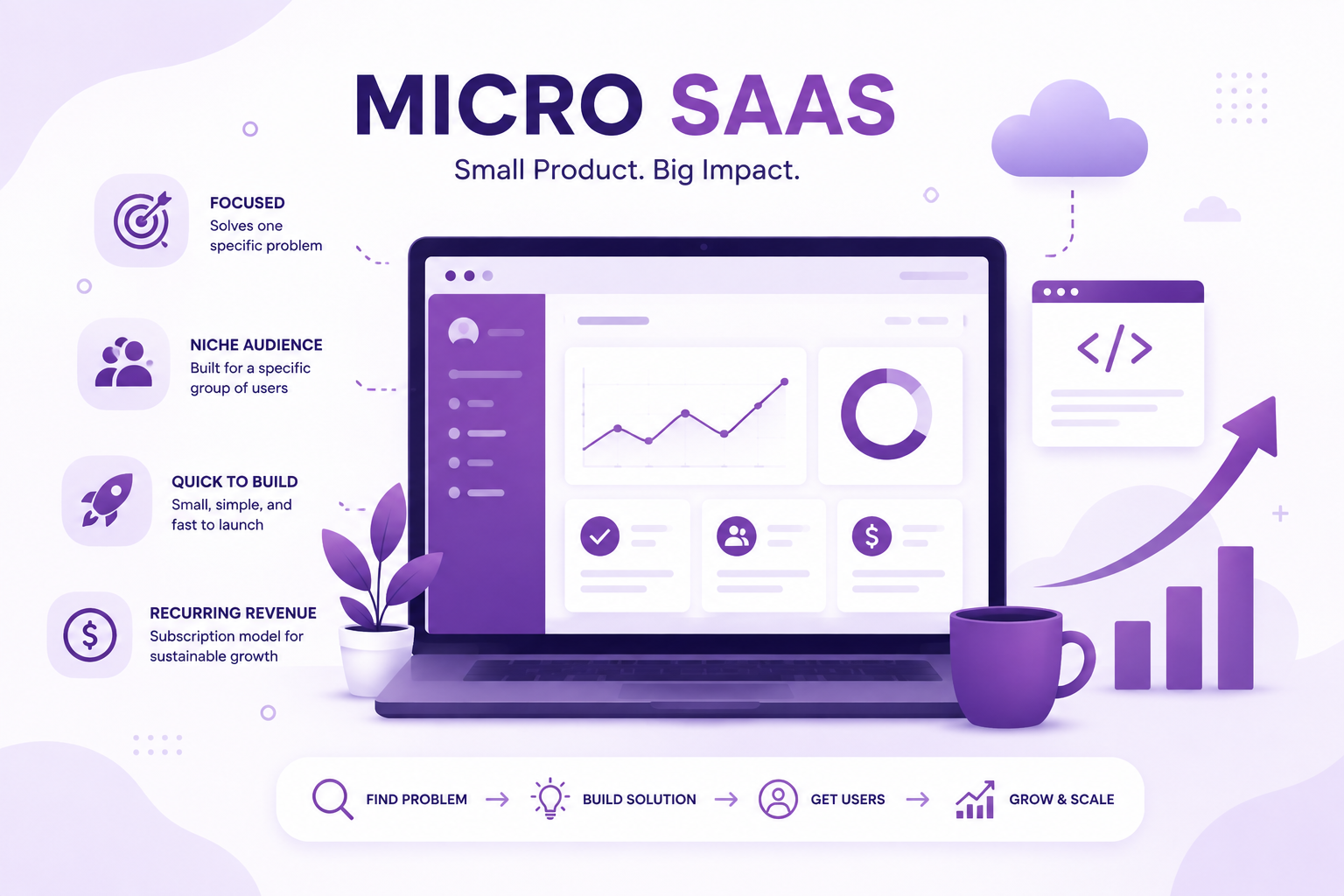
Have you ever had a simple software idea that could solve a very specific problem, but assumed you needed a large team, millions of dollars, and years of development to turn it into a real business?
You may not.
This is where Micro SaaS comes in.
Micro SaaS has become an interesting business model for developers, freelancers, entrepreneurs, and technical founders who want to build software products without creating a massive technology company.
Instead of trying to build the next Facebook, Shopify, or Microsoft, the idea is much simpler:
Find a specific problem. Build a simple solution. Serve a specific group of people. Charge them for the value you provide.
That is the basic idea behind Micro SaaS.
But what exactly is Micro SaaS, how does it work, and how can a beginner start building one?
Let's break it down.
What Is Micro SaaS?
Micro SaaS, short for Micro Software as a Service, is a small, focused software product designed to solve a specific problem for a specific group of users.
Unlike large SaaS platforms that may have hundreds of features, thousands of customers, large development teams, and significant operating costs, a Micro SaaS product is usually much more focused.
It may be built and operated by:
- One person
- A small development team
- A solo entrepreneur
- A developer working with a small business partner
The product typically solves one primary problem and generates revenue through a subscription, usage based pricing, one time payment, or another simple monetization model.
For example, imagine a tool that helps small businesses automatically convert bank statements from PDF files into organized CSV or Excel files.
It does not need to become a massive financial platform.
It simply needs to solve that particular problem exceptionally well.
That is the Micro SaaS mindset.
Micro SaaS vs Traditional SaaS
The biggest difference is usually scope.
A traditional SaaS company may attempt to solve multiple problems for a broad market.
A Micro SaaS product usually does the opposite.
It focuses on a narrow problem, a narrow audience, and a relatively small feature set.
Think about it this way:
Traditional SaaS:
"Let's build a complete project management platform."
Micro SaaS:
"Let's build a tool that automatically reminds small agencies when client invoices are overdue."
Both are software businesses.
But the second idea is much more focused.
That focus can make it easier to build, test, market, and improve the product.
What Makes a Product a Micro SaaS?
There is no single universal definition of Micro SaaS, but most Micro SaaS products share several characteristics.
1. It Solves a Specific Problem
A strong Micro SaaS product does not try to solve everything.
It identifies one painful or repetitive problem and creates a practical solution.
The more clearly you understand the problem, the easier it becomes to determine what features your product actually needs.
2. It Targets a Niche Audience
Micro SaaS products often target a specific group of users.
For example:
- Real estate agents
- Freelance designers
- Small accounting firms
- E-commerce sellers
- Content creators
- Recruitment agencies
- Developers
- Digital marketers
- Local service businesses
A smaller audience is not necessarily a disadvantage.
In many cases, a clearly defined niche makes marketing easier because you know exactly who you are trying to reach.
3. It Has a Small, Focused Feature Set
A Micro SaaS product should not need hundreds of features to deliver value.
The goal is to identify the minimum viable product, or MVP, that can solve the customer's primary problem.
Instead of building everything at once, start with what customers actually need.
4. It Can Be Operated by a Small Team
One of the attractions of Micro SaaS is the ability to operate with relatively few people.
Modern cloud infrastructure, APIs, automation, AI tools, payment systems, analytics platforms, and software development frameworks make it possible to build sophisticated products without maintaining a huge organization.
5. It Generates Recurring Revenue
Many Micro SaaS businesses use a subscription model.
For example:
$5/month
$10/month
$29/month
$49/month
The pricing depends entirely on the problem being solved and the value delivered.
Recurring revenue can make the business more predictable because customers continue paying while they continue receiving value.
Examples of Micro SaaS Ideas
You do not necessarily need a revolutionary invention to build a Micro SaaS.
Some of the best opportunities can come from boring, repetitive, frustrating tasks.
Here are some examples:
PDF to Excel or CSV Converter
A specialized tool that converts business documents into structured data.
Invoice Reminder Software
A simple platform that helps freelancers and small businesses track unpaid invoices and automatically remind clients.
AI Content Repurposing Tool
A tool that converts a long article, video transcript, or podcast into social media posts.
SEO Keyword Clustering Tool
A specialized application that groups related keywords to help content creators and SEO professionals plan their content.
Social Media Reporting Tool
A dashboard that automatically collects performance data and creates simple reports for agencies and their clients.
Appointment Reminder Tool
A lightweight platform designed specifically for a particular type of service business to reduce missed appointments.
Notice something important about these examples.
They are not trying to become everything for everyone.
They solve specific problems.
That is exactly where Micro SaaS opportunities often appear.
Why Are People Building Micro SaaS Businesses?
One major attraction is the relatively small scope compared with building a large software company.
Lower Initial Costs
You can start with a relatively small infrastructure footprint and scale as your customer base grows.
You may not need a large office, a huge development team, or expensive infrastructure from day one.
Faster Development
A focused product can often be developed much faster than a platform with hundreds of features.
This allows founders to get an MVP into the hands of users and start collecting feedback earlier.
Easier Validation
You do not need to spend months building a massive platform before discovering whether people actually want it.
You can build a smaller version, put it in front of potential customers, and learn from their response.
Niche Markets Can Be Valuable
Large companies often focus on huge markets.
That can leave smaller problems underserved.
A Micro SaaS founder can identify one of these underserved niches and build a product specifically for them.
Potential for Recurring Revenue
Subscription based Micro SaaS products can generate recurring revenue when customers continue finding value in the product.
For example, 100 customers paying $20 per month would generate:
$2,000 per month.
500 customers at the same price would generate:
$10,000 per month.
The important point is not the numbers themselves.
It is the relationship between customer value, pricing, retention, and acquisition.
A small customer base can become meaningful when the product solves a genuine problem.
How Do You Start a Micro SaaS Business?
You do not need to start by writing thousands of lines of code.
Start with the problem.
Step 1: Find a Real Problem
Look for repetitive tasks, frustrating workflows, expensive manual processes, and problems people repeatedly complain about.
Ask:
What do people currently do manually?
What takes too much time?
What software do they dislike using?
What task do they repeatedly pay someone else to perform?
These questions can reveal potential Micro SaaS opportunities.
Step 2: Identify Your Target Customer
Do not simply say:
"I want to build software for businesses."
That audience is too broad.
Instead, become specific.
For example:
"I want to build a tool for small Nigerian accounting firms that need to organize financial documents."
Now you have a clearer customer profile and a clearer problem to investigate.
Step 3: Validate the Idea
Before investing significant time and money, talk to potential users.
Find out whether the problem actually exists.
More importantly, find out whether it is painful enough for people to pay for a solution.
You want evidence, not assumptions.
Step 4: Build an MVP
An MVP, or Minimum Viable Product, is the simplest version of your product that can deliver the core value.
Do not build ten features when one feature can solve the customer's primary problem.
Your first objective should be:
Solve the problem.
Not:
Build the biggest application.
Step 5: Get Your First Users
Launch the product.
Give people an opportunity to use it.
Watch what they do.
Listen to their complaints.
Study what they like.
Find out where they get stuck.
Your first users can provide information that no amount of theoretical planning can replace.
Step 6: Improve Based on Feedback
Your first version will probably not be perfect.
That is normal.
Use real customer feedback to determine what should be improved, removed, automated, or added.
This prevents you from wasting resources building features nobody wants.
Step 7: Create a Sustainable Revenue Model
Once users are receiving value, determine how you will monetize the product.
Depending on the product, you could use:
- Monthly subscriptions
- Annual subscriptions
- Usage based pricing
- Freemium plans
- One time payments
- Paid upgrades
- Usage credits
The best model depends on the product and the value it provides.
Do You Need to Be a Professional Developer?
Not necessarily.
Technical skills can certainly make Micro SaaS development easier, especially when you can build, deploy, maintain, and improve the product yourself.
However, the most important skill is not simply coding.
It is problem identification.
You can build an incredibly sophisticated application and still fail if nobody needs it.
On the other hand, a relatively simple application can become valuable when it solves an important problem for the right audience.
That is why successful Micro SaaS development combines:
Technology + Problem Solving + Market Research + Distribution + Customer Feedback.
Common Micro SaaS Mistakes to Avoid
Many beginners make the same mistake.
They start with the technology instead of the problem.
They think:
"What application can I build?"
Instead of asking:
"What problem can I solve?"
Other common mistakes include:
- Building too many features
- Targeting everyone
- Ignoring customer feedback
- Failing to validate the idea
- Underpricing the product
- Spending too much before getting customers
- Ignoring marketing and distribution
- Focusing on development while neglecting customer acquisition
- Trying to compete directly with massive SaaS companies
Remember:
Small does not mean insignificant.
A small software product solving a painful problem for a well defined niche can be more valuable than a huge application that nobody really needs.
Is Micro SaaS Right for You?
Micro SaaS can be an interesting business model if you enjoy technology, problem solving, entrepreneurship, and building digital products.
You do not need to begin with a massive company.
You can start with one problem.
One customer type.
One useful feature.
One simple product.
Then improve it based on real market feedback.
The goal is not necessarily to build the next billion dollar technology company.
The goal could simply be to build a small, profitable, sustainable software business that solves a real problem.
And that is what makes Micro SaaS so interesting.
Start Small, Solve a Real Problem
The internet has created opportunities for people to build software products for very specific audiences around the world.
You can identify a problem in your industry, develop a solution, put it in front of potential users, and gradually turn that solution into a business.
The technology is only one part of the equation.
The real opportunity begins when you discover a problem people genuinely want solved.
If you have a software idea but need help turning that idea into a functional digital product, Zeecomedia's web application development services can help you move from concept to a practical software solution.
And if you already have a web application that needs technical improvements, updates, optimization, or ongoing management, you can explore our maintenance and support services.
Your next Micro SaaS idea might not need to be complicated.
It just needs to solve a problem that matters.